Precision Under Pressure: Aerospace Machining in 2026
- Sanjay Venkatesh
- October 23, 2026
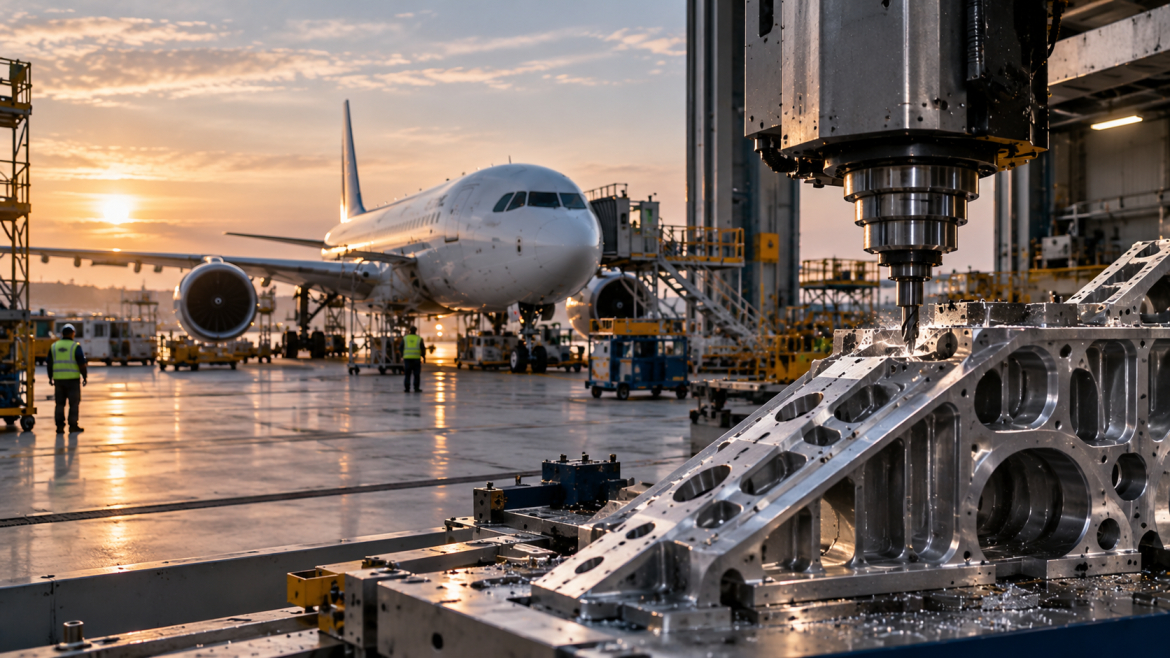
Commercial aerospace has never had more demand and has rarely struggled more to meet it. Airbus closed the first half of 2026 with a record backlog of 9,222 aircraft, and industry-wide unfilled orders stand near 17,000 jets — more than a decade of output at today’s rates. The constraint is no longer the order book. It is how fast the supply chain can turn a 3D model into a flight-ready part, first time, every time.
Industry trends and challenges
The gap between what OEMs want to build and what suppliers can make is structural, not temporary. A July 2026 Bain & Company review of 15 US and European programmes found production targets running 20% to 500% above recent levels, with 87% of programmes citing supplier bottlenecks as a core obstacle (Aviation Business News). Four pressures stand out for machined aerostructures:
- Rate ramps meet a shared sub-tier. Airbus is pushing the A320 family toward 75 a month, and Boeing is stepping up 737 Max outputs under FAA oversight. Both draw on the same castings, forgings and machined-part suppliers, so no single customer’s forecast shows the combined surge those suppliers face.
- The skills gap is in programming, not just operating. The scarcest people are 5-axis CNC programmers with aerospace experience. In Canada’s Saint-Hubert cluster, suppliers are paying 18–25% salary premiums to poach them (KiTalent), and senior programmers have become the bottleneck that idles expensive machines.
- Scaling squeezes unit economics. Bain notes that ramping up resets capital costs and spikes working capital exactly when suppliers are most cash-constrained — so every hour of spindle time wasted on test cuts or rework hurts more.
- Quality escapes are costlier than ever. With airframes already waiting on engines and parts, a non-conforming part does not just cost scrap; it costs a delivery slot.
How the industry is responding
The answers emerging across the supply chain share one idea: get more output from the engineers, machines and data already in place.
- Investing directly in suppliers. GE Aerospace has committed more than $100 million to supplier investment in 2026.
- Data platforms that close the loop on quality. Airbus credits its Skywise platform with cutting A350 delivery lead times by 33% through faster resolution of supply-chain quality issues. Bain calls digital forecasting and predictive supplier analytics the biggest competitive lever of the next five years.
- AI-assisted CAM and simulation. Rather than replacing programmers, shops are using AI and validated machining knowledge to make each senior programmer go further and shorten the ramp for juniors. Virtual verification (VERICUT and similar) catches collisions before a part ever touches a machine.
- Distributed engineering. With senior CNC programmers impossible to hire locally, even suppliers that once insisted on on-site programmers now accept remote talent (KiTalent). That opens the door to offshore engineering partners who already know OEM standards.
- Back-office automation. RFQs, BOMs, first article inspection paperwork and ERP entry still consume skilled hours that robotic process automation can return to engineering.
What Neviton is doing in aerospace machining
At Neviton, we guarantee a minimum 10% cycle time reduction on every engagement, and on plate and sheet metal programmes we routinely deliver 40–50%. We get there by encoding decades of aerospace machining experience into proprietary tools, then wrapping them in a complete engineering service from Bengaluru and the USA.
M2 Parameter Engine — First Time Right from line one. The costliest waste in aerospace CNC work is wrong feeds, speeds and toolpath strategies, discovered through three to five rounds of test cuts. M2 calculates optimal cutting conditions for each combination of material (titanium, steel, aluminum, composites), machine and part geometry before the program is written. It is validated on Makino, DMG, HAAS, Handtmann, Chiron and Mazak machines and integrates with Mastercam, CATIA, Power Mill and UG NX.
AI-powered STEP Estimator — quotes in hours, not weeks. Upload a STEP file and our AI, trained on 2,500+ delivered aerospace parts, extracts features and predicts both CAM programming time and machining cycle time per operation. Suppliers can answer RFQs faster and protect margin from underestimated programmes.
Full-spectrum engineering under one roof:
- CAM programming — 3- and 5-axis NC for sheet metal, plate and extrusion parts, with VERICUT-validated programs and shop-floor support through FAI. 4,800+ machine hours and $480K+ in capacity saved each year.
- CAD and 3D modelling — 1,500+ models created and 5,000+ validated to OEM standards, with full GD&T.
- Methods engineering — BOM, PFC and Master Process Sheets in Boeing and Airbus formats; 2,000+ FAI packages delivered.
- Tooling design — 450+ NC fixtures, forming tools, composite tooling and assembly jigs.
- CMM programming — inspection programs built from the same 3D models and GD&T, so first article and production parts are verified quickly and consistently against OEM requirements.
- RPA bots — up to 92% faster FAI data entry and 83% faster RFQ BOM breakdown.
Proven at scale. Over a 4+ year engagement with Spirit AeroSystems on Boeing work, we supported three plants in Romania and Vietnam with every one of these capabilities. The programme delivered 5,000+ parts and saved more than 50% of machine time. Our work spans primary to tertiary structures on Airbus A220–A350, Boeing 737–787, Bombardier Global and Challenger, Embraer, Gulfstream, Dassault Falcon and Bell programmes, for suppliers including Magellan, Mecachrome, Figeac Aero, Turkish Aerospace and Sansera (Neviton).
The Dassault partnership – a key factor in our ability to deliver cutting edge solutions to the market has been the partnership with Dassault systems. Their flagship product – Catia which we use extensively for CAD, Fixture Design and CAM has helped position us one of the leading specialty provider of Manufacturing Engineering services.
The bottom line
The aerospace backlog will not be cleared by more machines alone; it will be cleared by making every programmer, every spindle hour and every first article count. That is the problem Neviton was built to solve.

Recent Posts
-
From Prototypes to Production: How Additive Manufacturing is Shaping Atmanirbhar Bharat
The conversation around additive manufacturing (AM) in India has evolved considerably over the past decade. What was once viewed primarily as a prototyping technology is…
-
Identify Stray Light in Imaging Systems with LightTools
Stray light is undesired light radiation that interacts with the components of a system and degrades its performance by generating noise, that significantly reduces image…
-
Redefining the Riding Experience with RAMSIS
In two‑wheeler design, comfort and safety start with the rider. RAMSIS (Realistic Anthropometric Mathematical System of Interior Comfort Simulation) is an ergonomic simulation platform that…
-

Enhancing Product Understanding through 3D Technical Illustrator
The 3D Technical Illustrator role within the 3DEXPERIENCE Platform enables organizations to transform complex engineering data into clear, interactive, and visually rich technical documentation. In…
-
Transforming Physical Parts into Digital Models with CATIA 3DEXPERIENCE Reverse Engineer role
Reverse engineering has become a critical capability in modern product development, especially when working with legacy components, competitor benchmarking, or physical prototypes that lack digital…
-
Fixing Search Service Down Issue in 3DEXPERIENCE Platform
Search is one of the most critical features in the 3DEXPERIENCE platform. If the search service goes down, users cannot find objects, documents, or data—impacting…
-
Common Installation Errors and How to Fix Them in 3DEXPERIENCE
The 3DEXPERIENCE Platform is a powerful solution used by industries worldwide for product lifecycle management (PLM), simulation, and collaboration. However, installing 3DEXPERIENCE—especially on-premise—can be complex…
-
From Classroom to Industry: Empowering Future Engineers with the 3DEXPERIENCE Platform
In today’s fast-evolving engineering and design landscape, educational institutions must go beyond conventional CAD teaching methods. While standalone tools like CATIA V5, SOLIDWORKS, or traditional…
- Sanjay Venkatesh
- October 23, 2026
Precision Under Pressure: Aerospace Machining in 2026
Commercial aerospace has never had more demand and has rarely struggled more to meet it. Airbus closed the first half of 2026 with a record backlog of 9,222 aircraft, and industry-wide unfilled orders stand near 17,000 jets — more than a decade of output at today’s rates. The constraint is no longer the order book. It is how fast the supply chain can turn a 3D model into a flight-ready part, first time, every time.
Industry trends and challenges
The gap between what OEMs want to build and what suppliers can make is structural, not temporary. A July 2026 Bain & Company review of 15 US and European programmes found production targets running 20% to 500% above recent levels, with 87% of programmes citing supplier bottlenecks as a core obstacle (Aviation Business News). Four pressures stand out for machined aerostructures:
- Rate ramps meet a shared sub-tier. Airbus is pushing the A320 family toward 75 a month, and Boeing is stepping up 737 Max outputs under FAA oversight. Both draw on the same castings, forgings and machined-part suppliers, so no single customer’s forecast shows the combined surge those suppliers face.
- The skills gap is in programming, not just operating. The scarcest people are 5-axis CNC programmers with aerospace experience. In Canada’s Saint-Hubert cluster, suppliers are paying 18–25% salary premiums to poach them (KiTalent), and senior programmers have become the bottleneck that idles expensive machines.
- Scaling squeezes unit economics. Bain notes that ramping up resets capital costs and spikes working capital exactly when suppliers are most cash-constrained — so every hour of spindle time wasted on test cuts or rework hurts more.
- Quality escapes are costlier than ever. With airframes already waiting on engines and parts, a non-conforming part does not just cost scrap; it costs a delivery slot.
How the industry is responding
The answers emerging across the supply chain share one idea: get more output from the engineers, machines and data already in place.
- Investing directly in suppliers. GE Aerospace has committed more than $100 million to supplier investment in 2026.
- Data platforms that close the loop on quality. Airbus credits its Skywise platform with cutting A350 delivery lead times by 33% through faster resolution of supply-chain quality issues. Bain calls digital forecasting and predictive supplier analytics the biggest competitive lever of the next five years.
- AI-assisted CAM and simulation. Rather than replacing programmers, shops are using AI and validated machining knowledge to make each senior programmer go further and shorten the ramp for juniors. Virtual verification (VERICUT and similar) catches collisions before a part ever touches a machine.
- Distributed engineering. With senior CNC programmers impossible to hire locally, even suppliers that once insisted on on-site programmers now accept remote talent (KiTalent). That opens the door to offshore engineering partners who already know OEM standards.
- Back-office automation. RFQs, BOMs, first article inspection paperwork and ERP entry still consume skilled hours that robotic process automation can return to engineering.
What Neviton is doing in aerospace machining
At Neviton, we guarantee a minimum 10% cycle time reduction on every engagement, and on plate and sheet metal programmes we routinely deliver 40–50%. We get there by encoding decades of aerospace machining experience into proprietary tools, then wrapping them in a complete engineering service from Bengaluru and the USA.
M2 Parameter Engine — First Time Right from line one. The costliest waste in aerospace CNC work is wrong feeds, speeds and toolpath strategies, discovered through three to five rounds of test cuts. M2 calculates optimal cutting conditions for each combination of material (titanium, steel, aluminum, composites), machine and part geometry before the program is written. It is validated on Makino, DMG, HAAS, Handtmann, Chiron and Mazak machines and integrates with Mastercam, CATIA, Power Mill and UG NX.
AI-powered STEP Estimator — quotes in hours, not weeks. Upload a STEP file and our AI, trained on 2,500+ delivered aerospace parts, extracts features and predicts both CAM programming time and machining cycle time per operation. Suppliers can answer RFQs faster and protect margin from underestimated programmes.
Full-spectrum engineering under one roof:
- CAM programming — 3- and 5-axis NC for sheet metal, plate and extrusion parts, with VERICUT-validated programs and shop-floor support through FAI. 4,800+ machine hours and $480K+ in capacity saved each year.
- CAD and 3D modelling — 1,500+ models created and 5,000+ validated to OEM standards, with full GD&T.
- Methods engineering — BOM, PFC and Master Process Sheets in Boeing and Airbus formats; 2,000+ FAI packages delivered.
- Tooling design — 450+ NC fixtures, forming tools, composite tooling and assembly jigs.
- CMM programming — inspection programs built from the same 3D models and GD&T, so first article and production parts are verified quickly and consistently against OEM requirements.
- RPA bots — up to 92% faster FAI data entry and 83% faster RFQ BOM breakdown.
Proven at scale. Over a 4+ year engagement with Spirit AeroSystems on Boeing work, we supported three plants in Romania and Vietnam with every one of these capabilities. The programme delivered 5,000+ parts and saved more than 50% of machine time. Our work spans primary to tertiary structures on Airbus A220–A350, Boeing 737–787, Bombardier Global and Challenger, Embraer, Gulfstream, Dassault Falcon and Bell programmes, for suppliers including Magellan, Mecachrome, Figeac Aero, Turkish Aerospace and Sansera (Neviton).
The Dassault partnership – a key factor in our ability to deliver cutting edge solutions to the market has been the partnership with Dassault systems. Their flagship product – Catia which we use extensively for CAD, Fixture Design and CAM has helped position us one of the leading specialty provider of Manufacturing Engineering services.
The bottom line
The aerospace backlog will not be cleared by more machines alone; it will be cleared by making every programmer, every spindle hour and every first article count. That is the problem Neviton was built to solve.