Understanding the Architecture of the 3DEXPERIENCE Platform
- Akshay Hedaoo
- September 3, 2025
In today’s rapidly evolving engineering landscape, digital transformation often stalls when critical data like CAD files, simulation results, or change orders – reside in isolated silos. Dassault Systèmes’ 3DEXPERIENCE Platform addresses this challenge. It offers a unified, service-oriented foundation that spans the entire product lifecycle – from concept and design to manufacturing and after-sales.
In this post, we’ll break down the 3DEXPERIENCE architecture layer by layer, helping system architects, IT admins, and engineers understand how it scales, how it protects IP, and where to extend its capabilities.
High-Level Architecture: The Three-Tier Bedrock
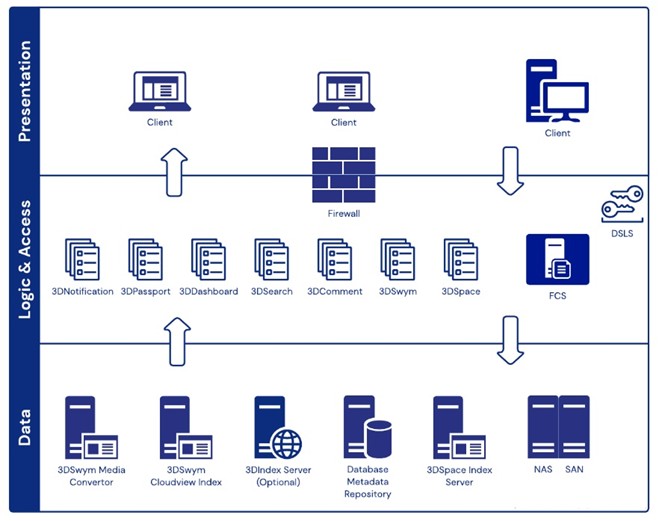
At its core, the 3DEXPERIENCE platform is structured around a classic three-tier architecture:
- Client Tier
- Application Tier
- Data Tier
While this model is familiar in IT, 3DEXPERIENCE tailors it for product lifecycle management (PLM) and real-time 3D collaboration, enabling each layer to evolve independently while supporting a seamless user experience.
Client Tier: UX Without Borders
The client tier ensures users can access the platform anytime, anywhere, using tools best suited for their role:
- Web Top (Zero Footprint): Launch dashboards, BOM views, or tasks directly from a browser – no installations or plugins needed.
- Rich Native Apps: Power users benefit from GPU-accelerated tools like CATIA, DELMIA, and SIMULIA.
- Mobile Apps: Engineers can review 3D models, approve changes, or report issues from iOS/Android devices, even with limited bandwidth.
- Unified Security: Whether on-site or remote, users go through a consistent SSO and TLS handshake, ensuring both convenience and security.
Application Tier: Microservices in Concert
The platform’s microservice architecture ensures modularity, scalability, and agility. Key services include:
| Micro-service | Core Duty | Scale Strategy |
| 3DSpace | Manages PLM objects, lifecycles, and revisions | Add nodes for metadata-heavy operations |
| 3DSearch | Provides full-text and semantic search | Shard index clusters for high throughput |
| FCS/MCS | Manages binaries and delta caching | Geo-distributed for global performance |
| 3DDashboard & Compass | Widget shell and launcher for apps | Stateless scale out freely |
| Workflow/Notification | Automates tasks and notifications | Horizontal scaling via JMS queues |
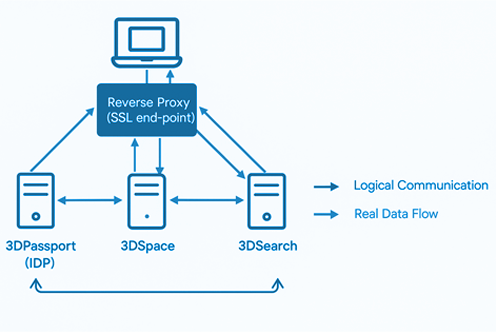
All services are exposed via REST APIs, with SOAP and CAA options for legacy or deep integrations.
Data Tier: A Single Source of Truth
A strong data layer ensures data integrity and performance:
- Metadata Layer: Backed by Oracle or PostgreSQL, supporting hundreds of object types and customizable schemas.
- Vault Servers: Deduplicated, compressed file storage with efficient delta transfers.
- Exalead Index: Enables faceted, semantic, and full-text search across metadata and file contents.
- Resilience: Disaster recovery topologies replicate databases and file vaults across sites, while index clusters self-rehydrate.
Infrastructure & Deployment: Pick Your Cloud
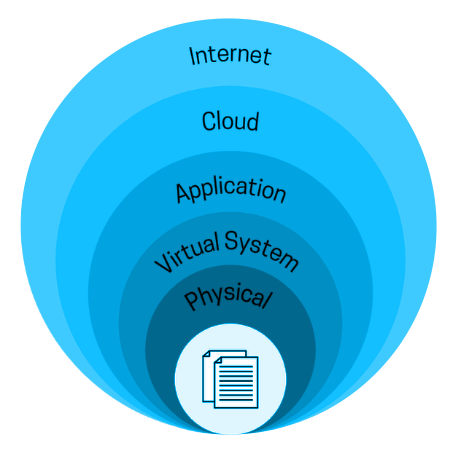
Choose the right deployment model for your needs:
| Model | Footprint | Best For |
| On-Premise | Physical/ VM-based with self-managed stack | Industries like aerospace with strict security needs |
| Private Cloud | OpenShift/ Kubernetes | Enterprises needing elasticity with control |
| SaaS/ 3DEXPERIENCE Works | Fully managed by Dassault Systèmes | SMBs preferring simplicity and low overhead |
Regardless of mode, all setups use Apache TomEE, reverse proxies, and sticky session load-balancers enabling smooth migration between models.
Security: Trust by Design
Security is deeply integrated into every layer:
- Authentication: Supports SAML, Kerberos, LDAP, and OAuth2.
- Authorization: Contextual RBAC for example, suppliers can download STEP files but not native CAD.
- Encryption: TLS 1.3 in transit, with optional AES-256 at rest.
- Audit Logging: Immutable records for all object events ensure compliance.
Extensibility: From No-Code to Full-Code
Whether you’re a business analyst or a hardcore developer, there’s a way to customize the platform:
- CAA V6 SDK: Extend the platform with C++/Java add custom menus, commands, or background services.
- EKL (Engineering Knowledge Language): Create design rules, validation checks, and automation scripts.
- REST Widgets: Build JavaScript-based mashups that integrate PLM data with tools like Jira, SAP, or IIoT.
- Business Process Templates: Drag-and-drop editor for change workflows—no code required.
Why This Architecture Matters
| Benefit | Impact |
| Unified Data | Eliminates duplication across BOMs, CAD files, and workflows |
| Real-Time Collaboration | Teams across continents work on the same model in real time |
| Elastic Scalability | Add compute or storage nodes without disruption |
| Defense-Grade Security | Meets compliance without expensive rewrites |
| Lower TCO | One platform replaces multiple disconnected systems |
Conclusion
The 3DEXPERIENCE Platform isn’t just a set of tools – it’s an ecosystem built on a robust, scalable, and secure architecture. By understanding its layered design – from clients and services to data and extensibility – you’re better equipped to deploy it strategically, customize it safely, and grow it alongside your innovation goals.

Recent Posts
-
From Prototypes to Production: How Additive Manufacturing is Shaping Atmanirbhar Bharat
The conversation around additive manufacturing (AM) in India has evolved considerably over the past decade. What was once viewed primarily as a prototyping technology is…
-
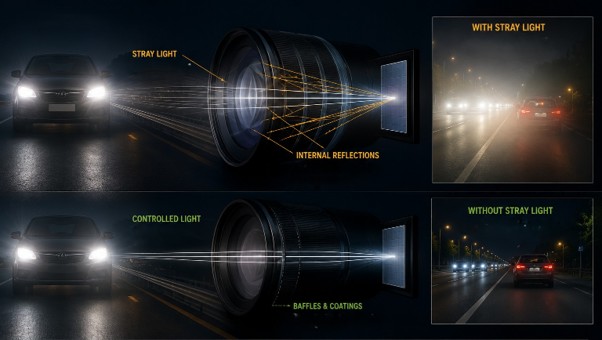
Identify Stray Light in Imaging Systems with LightTools
Stray light is undesired light radiation that interacts with the components of a system and degrades its performance by generating noise, that significantly reduces image…
-
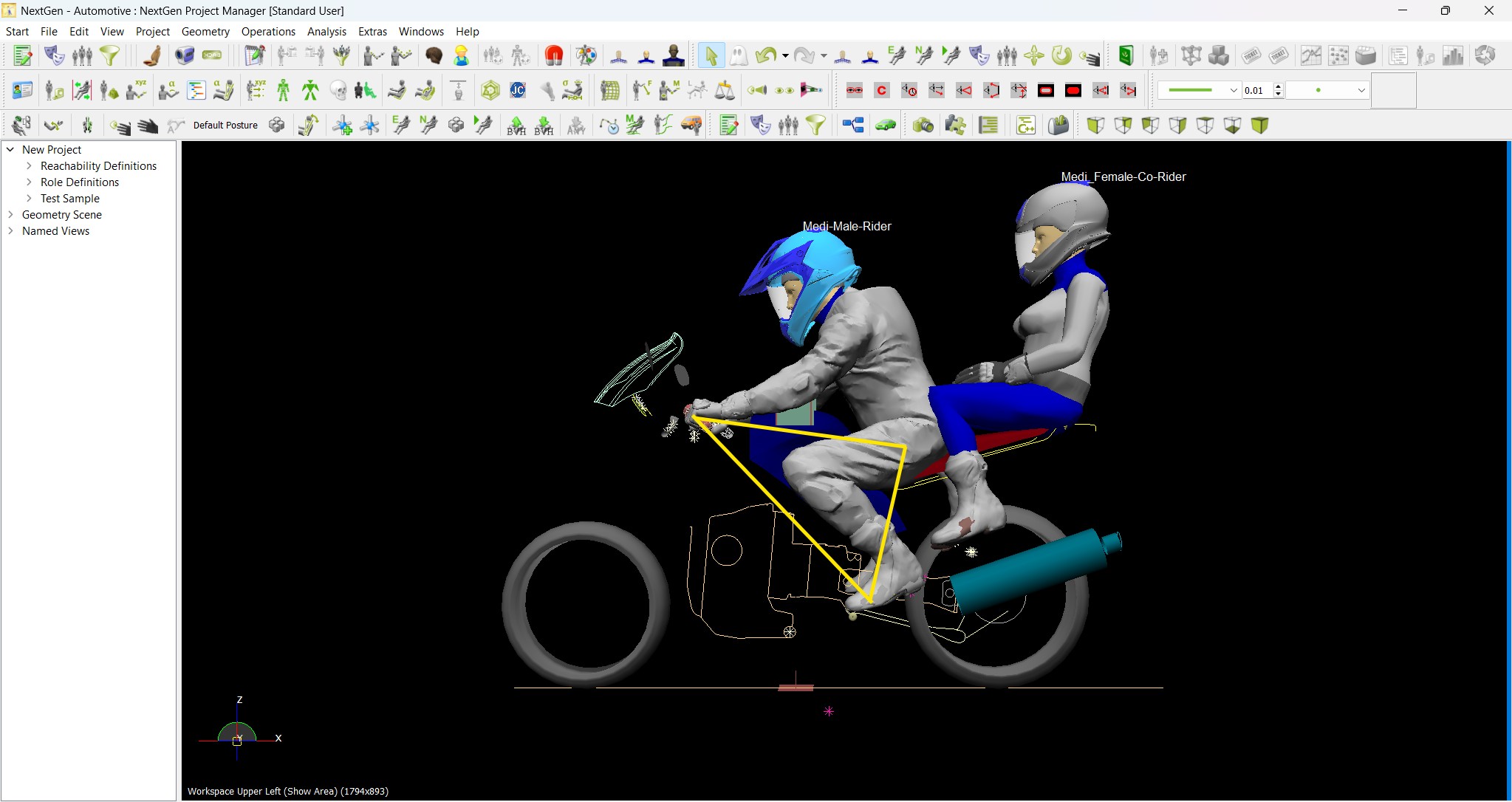
Redefining the Riding Experience with RAMSIS
In two‑wheeler design, comfort and safety start with the rider. RAMSIS (Realistic Anthropometric Mathematical System of Interior Comfort Simulation) is an ergonomic simulation platform that…
-
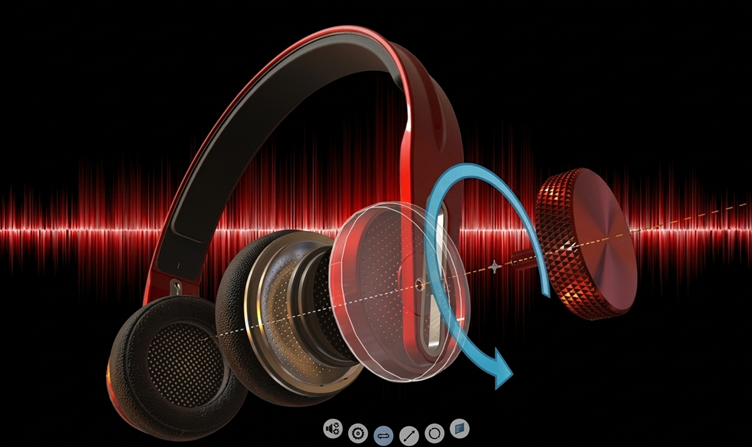
Enhancing Product Understanding through 3D Technical Illustrator
The 3D Technical Illustrator role within the 3DEXPERIENCE Platform enables organizations to transform complex engineering data into clear, interactive, and visually rich technical documentation. In…
-

Transforming Physical Parts into Digital Models with CATIA 3DEXPERIENCE Reverse Engineer role
Reverse engineering has become a critical capability in modern product development, especially when working with legacy components, competitor benchmarking, or physical prototypes that lack digital…
-
Fixing Search Service Down Issue in 3DEXPERIENCE Platform
Search is one of the most critical features in the 3DEXPERIENCE platform. If the search service goes down, users cannot find objects, documents, or data—impacting…
-
Common Installation Errors and How to Fix Them in 3DEXPERIENCE
The 3DEXPERIENCE Platform is a powerful solution used by industries worldwide for product lifecycle management (PLM), simulation, and collaboration. However, installing 3DEXPERIENCE—especially on-premise—can be complex…
-
From Classroom to Industry: Empowering Future Engineers with the 3DEXPERIENCE Platform
In today’s fast-evolving engineering and design landscape, educational institutions must go beyond conventional CAD teaching methods. While standalone tools like CATIA V5, SOLIDWORKS, or traditional…
- Akshay Hedaoo
- September 3, 2025
Understanding the Architecture of the 3DEXPERIENCE Platform
In today’s rapidly evolving engineering landscape, digital transformation often stalls when critical data like CAD files, simulation results, or change orders – reside in isolated silos. Dassault Systèmes’ 3DEXPERIENCE Platform addresses this challenge. It offers a unified, service-oriented foundation that spans the entire product lifecycle – from concept and design to manufacturing and after-sales.
In this post, we’ll break down the 3DEXPERIENCE architecture layer by layer, helping system architects, IT admins, and engineers understand how it scales, how it protects IP, and where to extend its capabilities.
High-Level Architecture: The Three-Tier Bedrock
At its core, the 3DEXPERIENCE platform is structured around a classic three-tier architecture:
- Client Tier
- Application Tier
- Data Tier
While this model is familiar in IT, 3DEXPERIENCE tailors it for product lifecycle management (PLM) and real-time 3D collaboration, enabling each layer to evolve independently while supporting a seamless user experience.
Client Tier: UX Without Borders
The client tier ensures users can access the platform anytime, anywhere, using tools best suited for their role:
- Web Top (Zero Footprint): Launch dashboards, BOM views, or tasks directly from a browser – no installations or plugins needed.
- Rich Native Apps: Power users benefit from GPU-accelerated tools like CATIA, DELMIA, and SIMULIA.
- Mobile Apps: Engineers can review 3D models, approve changes, or report issues from iOS/Android devices, even with limited bandwidth.
- Unified Security: Whether on-site or remote, users go through a consistent SSO and TLS handshake, ensuring both convenience and security.
Application Tier: Microservices in Concert
The platform’s microservice architecture ensures modularity, scalability, and agility. Key services include:
| Micro-service | Core Duty | Scale Strategy |
| 3DSpace | Manages PLM objects, lifecycles, and revisions | Add nodes for metadata-heavy operations |
| 3DSearch | Provides full-text and semantic search | Shard index clusters for high throughput |
| FCS/MCS | Manages binaries and delta caching | Geo-distributed for global performance |
| 3DDashboard & Compass | Widget shell and launcher for apps | Stateless scale out freely |
| Workflow/Notification | Automates tasks and notifications | Horizontal scaling via JMS queues |
All services are exposed via REST APIs, with SOAP and CAA options for legacy or deep integrations.
Data Tier: A Single Source of Truth
A strong data layer ensures data integrity and performance:
- Metadata Layer: Backed by Oracle or PostgreSQL, supporting hundreds of object types and customizable schemas.
- Vault Servers: Deduplicated, compressed file storage with efficient delta transfers.
- Exalead Index: Enables faceted, semantic, and full-text search across metadata and file contents.
- Resilience: Disaster recovery topologies replicate databases and file vaults across sites, while index clusters self-rehydrate.
Infrastructure & Deployment: Pick Your Cloud
Choose the right deployment model for your needs:
| Model | Footprint | Best For |
| On-Premise | Physical/ VM-based with self-managed stack | Industries like aerospace with strict security needs |
| Private Cloud | OpenShift/ Kubernetes | Enterprises needing elasticity with control |
| SaaS/ 3DEXPERIENCE Works | Fully managed by Dassault Systèmes | SMBs preferring simplicity and low overhead |
Regardless of mode, all setups use Apache TomEE, reverse proxies, and sticky session load-balancers enabling smooth migration between models.
Security: Trust by Design
Security is deeply integrated into every layer:
- Authentication: Supports SAML, Kerberos, LDAP, and OAuth2.
- Authorization: Contextual RBAC for example, suppliers can download STEP files but not native CAD.
- Encryption: TLS 1.3 in transit, with optional AES-256 at rest.
- Audit Logging: Immutable records for all object events ensure compliance.
Extensibility: From No-Code to Full-Code
Whether you’re a business analyst or a hardcore developer, there’s a way to customize the platform:
- CAA V6 SDK: Extend the platform with C++/Java add custom menus, commands, or background services.
- EKL (Engineering Knowledge Language): Create design rules, validation checks, and automation scripts.
- REST Widgets: Build JavaScript-based mashups that integrate PLM data with tools like Jira, SAP, or IIoT.
- Business Process Templates: Drag-and-drop editor for change workflows—no code required.
Why This Architecture Matters
| Benefit | Impact |
| Unified Data | Eliminates duplication across BOMs, CAD files, and workflows |
| Real-Time Collaboration | Teams across continents work on the same model in real time |
| Elastic Scalability | Add compute or storage nodes without disruption |
| Defense-Grade Security | Meets compliance without expensive rewrites |
| Lower TCO | One platform replaces multiple disconnected systems |
Conclusion
The 3DEXPERIENCE Platform isn’t just a set of tools – it’s an ecosystem built on a robust, scalable, and secure architecture. By understanding its layered design – from clients and services to data and extensibility – you’re better equipped to deploy it strategically, customize it safely, and grow it alongside your innovation goals.