Virtual Homologation of Truck Mirrors using CAVA
- Pranay Malewar
- August 22, 2025
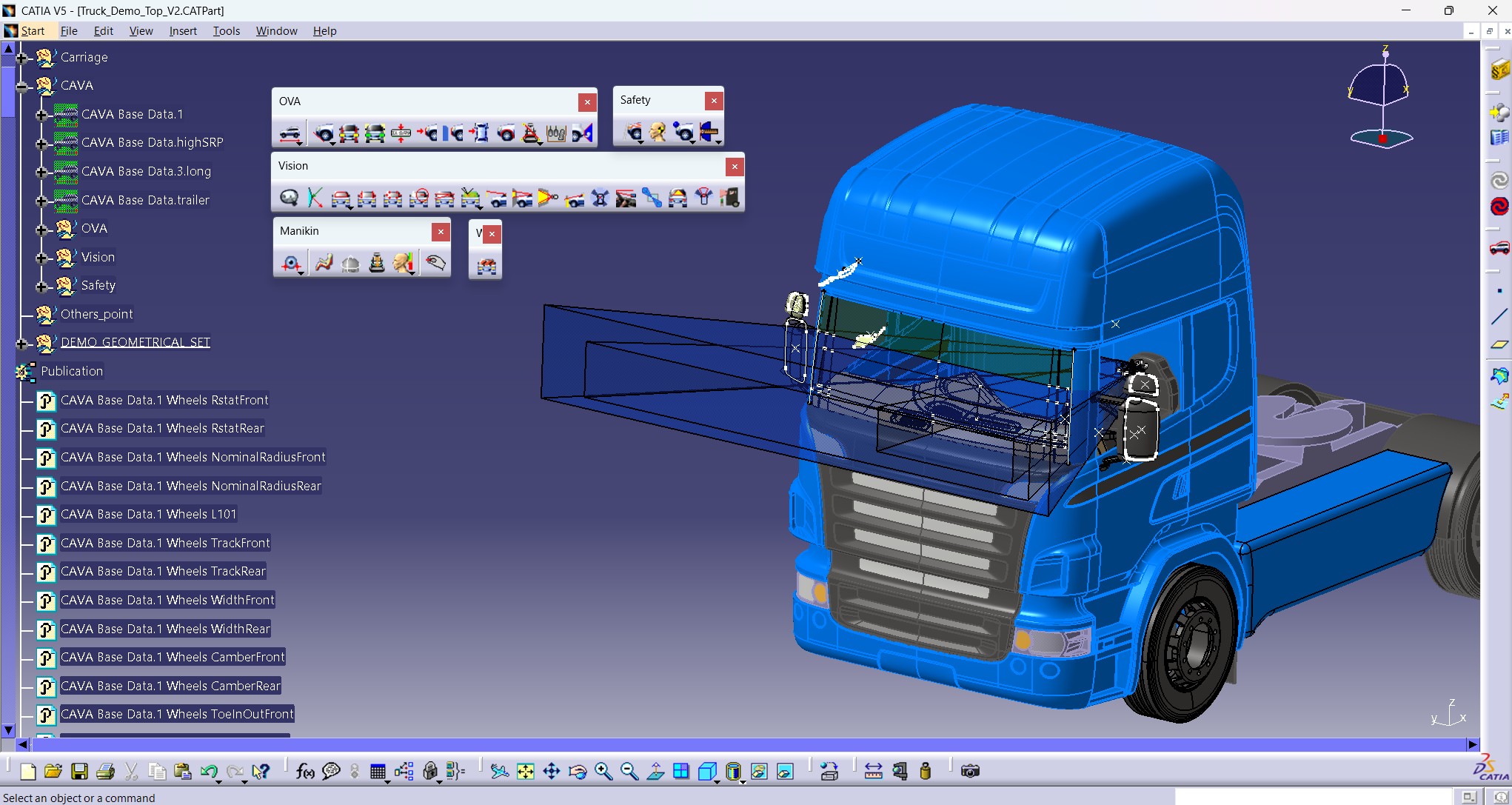
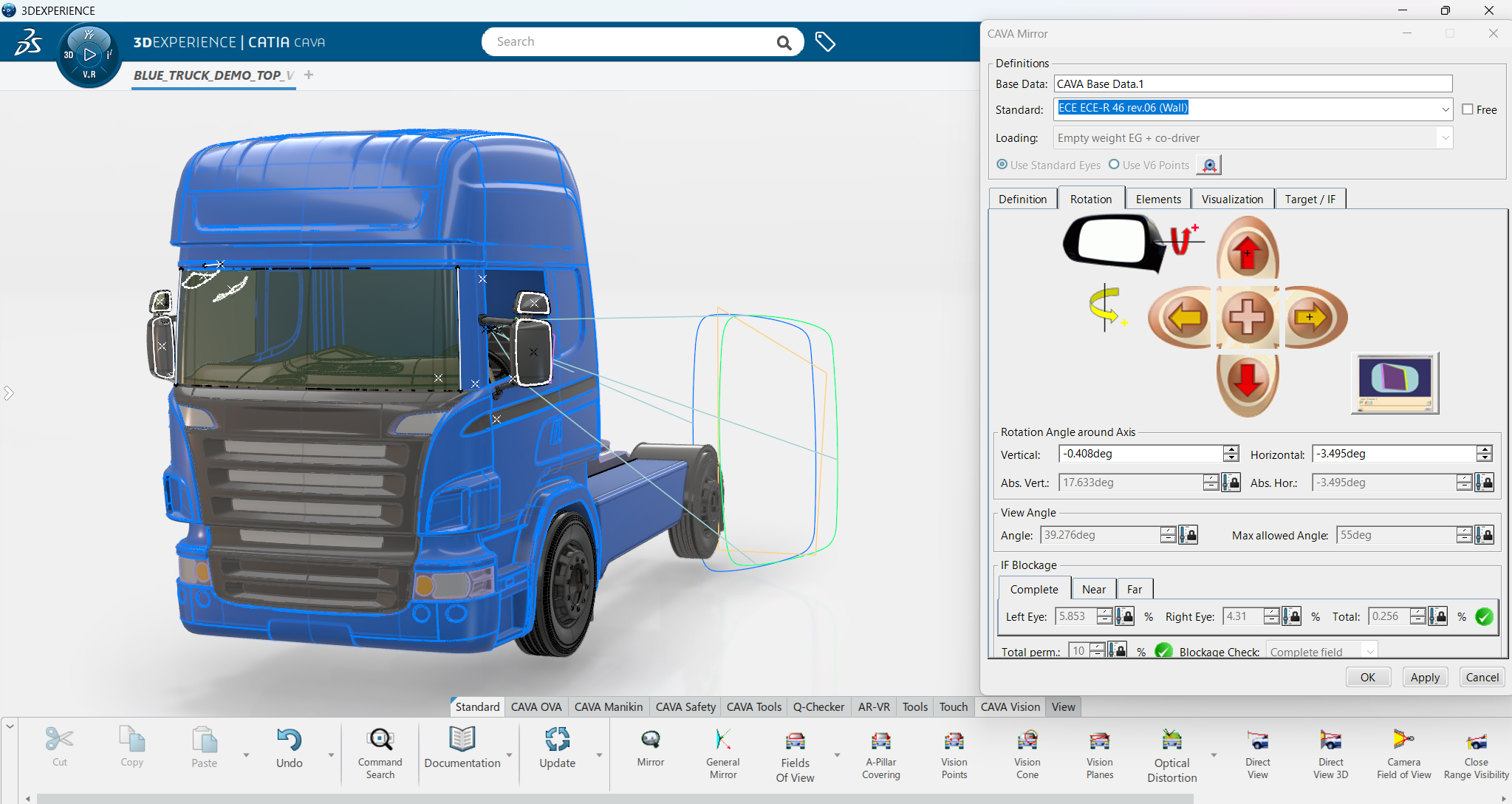
Virtual homologation is revolutionizing automotive mirror approval processes, especially for trucks subject to strict visibility and safety regulations. AIS 002 Rev. 1, the Indian Automotive Standard governing devices for indirect vision, defines comprehensive requirements for truck mirrors to ensure drivers have optimal visibility of critical blind spots around their vehicles. Traditional homologation of mirrors often involves extensive physical prototyping and testing. However, with Technia’s CAVA software – integrated seamlessly within CATIA V5 and the 3DEXPERIENCE platform – OEMs can now perform virtual homologation without installing additional applications. This integration allows mirror compliance checks directly within the vehicle’s CAD environment, accelerating development cycles and ensuring regulatory adherence from early design stages.
Understanding AIS 002 Rev. 1 for Trucks
AIS 002 Rev. 1 applies to rear-view mirrors and devices for indirect vision on trucks (N category vehicles), focusing on installation, positioning, and field of vision coverage critical to driver safety. Trucks must be equipped with main exterior mirrors on both driver and passenger sides, with additional wide-angle, close-proximity, and front mirrors mandated based on vehicle size (N2 and N3 categories). The regulation specifies minimum visibility zones that mirrors must cover, such as a 5-meter-wide rear road section extending from 10 to 30 meters behind the driver’s eye point (ocular points) set 65 mm apart horizontally and 635 mm above the R point (seating reference point). Mirrors must be mounted at stable positions, typically at least 2 meters above ground for close-proximity and front mirrors and must remain vibration-free under driving conditions to ensure uninterrupted visibility.
AIS 002 Rev. 1 (Wall) is a focused extension emphasizing “wall zones” – geometric visibility planes immediately adjacent to vehicle sides and front. It formalizes the measurement of blind spot coverage using reflective light and field-of-vision diagrams, pinpointing spatial zones critical for eliminating close-range blind spots. This part of the standard is especially crucial for large trucks to meet stringent safety regulations.
Mirror Classes Covered Under AIS 002 for Trucks Which Can Be Analyzed in CAVA as Well
AIS 002 Rev. 1 categorizes mirrors into specific classes based on their field of vision and application to ensure comprehensive coverage around trucks and related vehicles:
- Class II – Main Rear-View Device:
Covers a larger section behind and beside the vehicle. This is the primary exterior mirror used on all trucks for general rear visibility. - Class III – Main Rear-View Device (Alternative Orientation):
Often grouped with Class II, this class includes mirrors positioned or oriented differently but serving the main rear-view function, particularly on trucks. - Class IV – Wide-Angle Exterior Mirror:
Provides a wider lateral field of vision alongside the vehicle, reducing blind spots on the sides. These are especially important for large trucks to cover adjacent lanes. - Class V – Close-Proximity View Mirror:
Focuses on the area immediately beside the cab or vehicle body. These mirrors help drivers detect objects or pedestrians very close to the vehicle, enhancing safety in tight manoeuvres. - Class VI – Front View Device:
Covers the blind spot area directly in front of the truck that is not visible from the driver’s seat. This is critical for preventing collisions during low-speed or complex driving conditions. - Class VII – Main Rear-View Mirrors for L-Category Vehicles with Bodywork:
This class applies primarily to certain motorcycles and three-wheelers with enclosed bodies, ensuring adequate rear visibility for these smaller vehicle types.
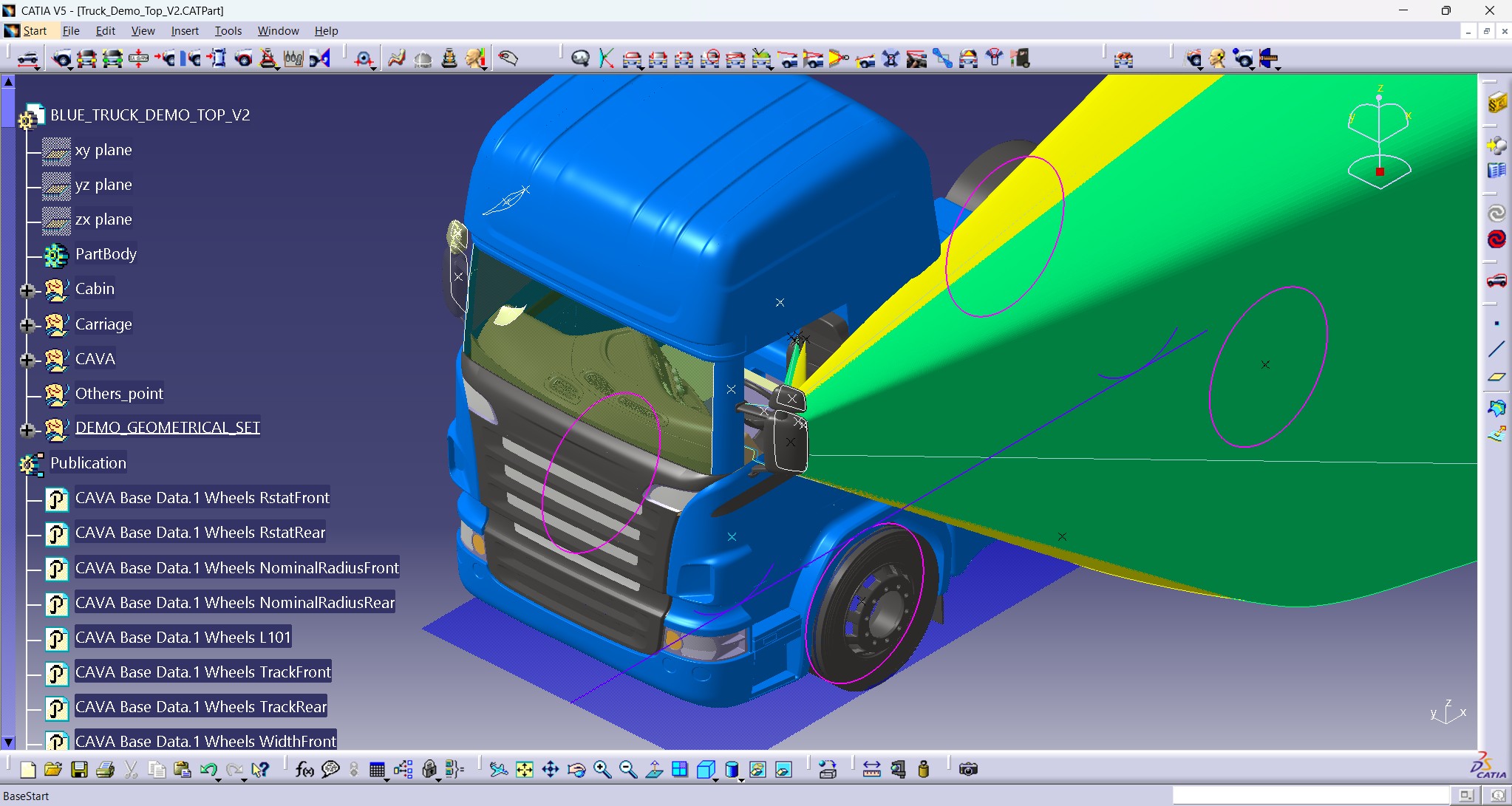
CAVA’s homologation process evaluates each mirror class according to its distinct parameters and prescribed fields of vision, ensuring full compliance with AIS 002 regulatory requirements.
CAVA’s Virtual Homologation Process for AIS 002
To initiate AIS 002 compliance checks in CAVA, three primary inputs are required:
- Mirror Surface Type (Planar, Toroidal, etc.)
- Rotation Point or Coordinates for mirror positioning
- Mirror Contour defining the geometric shape and boundaries of the mirror
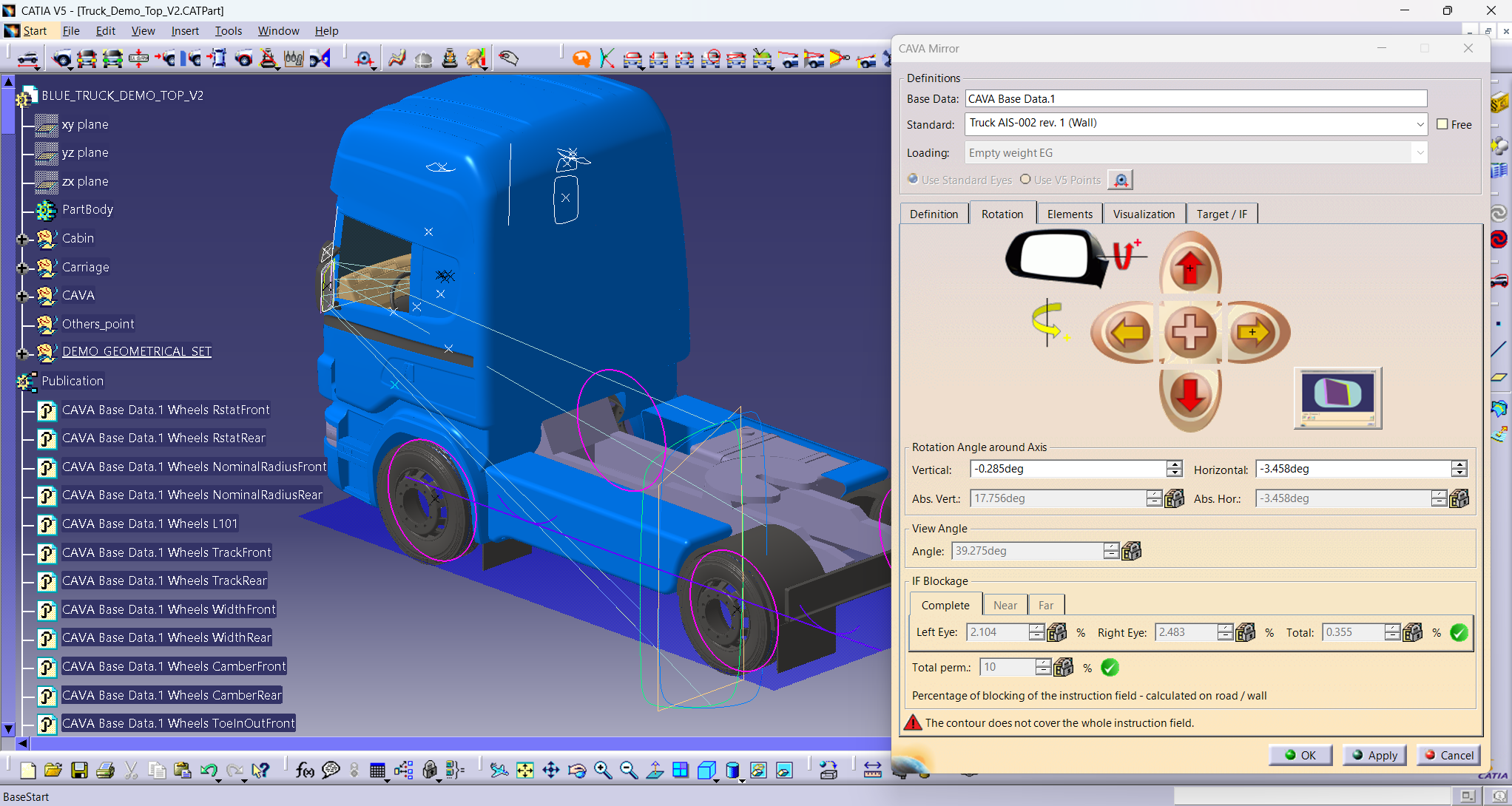
CAVA evaluates the mirror placement in relation to the vehicle’s geometry and simulates the driver’s ambinocular vision to check for field-of-vision compliance as per AIS 002. It also identifies any geometric element blockages that could impair mirror effectiveness.
The software provides clear visual feedback: a green tick signifies that the mirror configuration passes AIS 002 visibility and installation standards, while a red exclamation mark indicates a failure needing design modification.
Benefits of Integrating CAVA in Truck Mirror Homologation
- Streamlined Compliance: Automates mirror validation steps, minimizing manual measurement errors and expediting approval.
- Seamless CAD Integration: CAVA works inside CATIA V5 and 3DEXPERIENCE, avoiding the need for standalone tools or additional software installations.
- Supports Multiple Mirror Types: Enables homologation analysis across a broad spectrum of mirror geometries critical to truck regulations.
- Accurate Vision Modelling: Incorporates the driver’s ocular points and R point, ensuring realistic visibility simulations.
- Enhanced Safety Assurance: Assesses complex blind-spot “wall zones” coverage to adhere closely to AIS 002 (Wall) provisions.
Conclusion
AIS 002 Rev. 1 sets comprehensive standards for truck mirrors to maximize driver visibility and safety. Virtual homologation with CAVA transforms this traditionally cumbersome process into a more efficient, integrated, and precise digital workflow. By enabling advanced mirror type analysis, position verification, and geometric blockage checks within the familiar CAD environment, CAVA empowers OEMs to confidently meet AIS 002’s rigorous requirements while reducing time-to-market and resource expenditure. Virtual homologation with CAVA is the future of regulatory compliance for truck mirror systems.

Recent Posts
-
From Prototypes to Production: How Additive Manufacturing is Shaping Atmanirbhar Bharat
The conversation around additive manufacturing (AM) in India has evolved considerably over the past decade. What was once viewed primarily as a prototyping technology is…
-
Identify Stray Light in Imaging Systems with LightTools
Stray light is undesired light radiation that interacts with the components of a system and degrades its performance by generating noise, that significantly reduces image…
-
Redefining the Riding Experience with RAMSIS
In two‑wheeler design, comfort and safety start with the rider. RAMSIS (Realistic Anthropometric Mathematical System of Interior Comfort Simulation) is an ergonomic simulation platform that…
-
Enhancing Product Understanding through 3D Technical Illustrator
The 3D Technical Illustrator role within the 3DEXPERIENCE Platform enables organizations to transform complex engineering data into clear, interactive, and visually rich technical documentation. In…
-
Transforming Physical Parts into Digital Models with CATIA 3DEXPERIENCE Reverse Engineer role
Reverse engineering has become a critical capability in modern product development, especially when working with legacy components, competitor benchmarking, or physical prototypes that lack digital…
-
Fixing Search Service Down Issue in 3DEXPERIENCE Platform
Search is one of the most critical features in the 3DEXPERIENCE platform. If the search service goes down, users cannot find objects, documents, or data—impacting…
-
Common Installation Errors and How to Fix Them in 3DEXPERIENCE
The 3DEXPERIENCE Platform is a powerful solution used by industries worldwide for product lifecycle management (PLM), simulation, and collaboration. However, installing 3DEXPERIENCE—especially on-premise—can be complex…
-
From Classroom to Industry: Empowering Future Engineers with the 3DEXPERIENCE Platform
In today’s fast-evolving engineering and design landscape, educational institutions must go beyond conventional CAD teaching methods. While standalone tools like CATIA V5, SOLIDWORKS, or traditional…
- Pranay Malewar
- August 22, 2025
Virtual Homologation of Truck Mirrors using CAVA
Virtual homologation is revolutionizing automotive mirror approval processes, especially for trucks subject to strict visibility and safety regulations. AIS 002 Rev. 1, the Indian Automotive Standard governing devices for indirect vision, defines comprehensive requirements for truck mirrors to ensure drivers have optimal visibility of critical blind spots around their vehicles. Traditional homologation of mirrors often involves extensive physical prototyping and testing. However, with Technia’s CAVA software – integrated seamlessly within CATIA V5 and the 3DEXPERIENCE platform – OEMs can now perform virtual homologation without installing additional applications. This integration allows mirror compliance checks directly within the vehicle’s CAD environment, accelerating development cycles and ensuring regulatory adherence from early design stages.
Understanding AIS 002 Rev. 1 for Trucks
AIS 002 Rev. 1 applies to rear-view mirrors and devices for indirect vision on trucks (N category vehicles), focusing on installation, positioning, and field of vision coverage critical to driver safety. Trucks must be equipped with main exterior mirrors on both driver and passenger sides, with additional wide-angle, close-proximity, and front mirrors mandated based on vehicle size (N2 and N3 categories). The regulation specifies minimum visibility zones that mirrors must cover, such as a 5-meter-wide rear road section extending from 10 to 30 meters behind the driver’s eye point (ocular points) set 65 mm apart horizontally and 635 mm above the R point (seating reference point). Mirrors must be mounted at stable positions, typically at least 2 meters above ground for close-proximity and front mirrors and must remain vibration-free under driving conditions to ensure uninterrupted visibility.
AIS 002 Rev. 1 (Wall) is a focused extension emphasizing “wall zones” – geometric visibility planes immediately adjacent to vehicle sides and front. It formalizes the measurement of blind spot coverage using reflective light and field-of-vision diagrams, pinpointing spatial zones critical for eliminating close-range blind spots. This part of the standard is especially crucial for large trucks to meet stringent safety regulations.
Mirror Classes Covered Under AIS 002 for Trucks Which Can Be Analyzed in CAVA as Well
AIS 002 Rev. 1 categorizes mirrors into specific classes based on their field of vision and application to ensure comprehensive coverage around trucks and related vehicles:
- Class II – Main Rear-View Device:
Covers a larger section behind and beside the vehicle. This is the primary exterior mirror used on all trucks for general rear visibility. - Class III – Main Rear-View Device (Alternative Orientation):
Often grouped with Class II, this class includes mirrors positioned or oriented differently but serving the main rear-view function, particularly on trucks. - Class IV – Wide-Angle Exterior Mirror:
Provides a wider lateral field of vision alongside the vehicle, reducing blind spots on the sides. These are especially important for large trucks to cover adjacent lanes. - Class V – Close-Proximity View Mirror:
Focuses on the area immediately beside the cab or vehicle body. These mirrors help drivers detect objects or pedestrians very close to the vehicle, enhancing safety in tight manoeuvres. - Class VI – Front View Device:
Covers the blind spot area directly in front of the truck that is not visible from the driver’s seat. This is critical for preventing collisions during low-speed or complex driving conditions. - Class VII – Main Rear-View Mirrors for L-Category Vehicles with Bodywork:
This class applies primarily to certain motorcycles and three-wheelers with enclosed bodies, ensuring adequate rear visibility for these smaller vehicle types.
CAVA’s homologation process evaluates each mirror class according to its distinct parameters and prescribed fields of vision, ensuring full compliance with AIS 002 regulatory requirements.
CAVA’s Virtual Homologation Process for AIS 002
To initiate AIS 002 compliance checks in CAVA, three primary inputs are required:
- Mirror Surface Type (Planar, Toroidal, etc.)
- Rotation Point or Coordinates for mirror positioning
- Mirror Contour defining the geometric shape and boundaries of the mirror
CAVA evaluates the mirror placement in relation to the vehicle’s geometry and simulates the driver’s ambinocular vision to check for field-of-vision compliance as per AIS 002. It also identifies any geometric element blockages that could impair mirror effectiveness.
The software provides clear visual feedback: a green tick signifies that the mirror configuration passes AIS 002 visibility and installation standards, while a red exclamation mark indicates a failure needing design modification.
Benefits of Integrating CAVA in Truck Mirror Homologation
- Streamlined Compliance: Automates mirror validation steps, minimizing manual measurement errors and expediting approval.
- Seamless CAD Integration: CAVA works inside CATIA V5 and 3DEXPERIENCE, avoiding the need for standalone tools or additional software installations.
- Supports Multiple Mirror Types: Enables homologation analysis across a broad spectrum of mirror geometries critical to truck regulations.
- Accurate Vision Modelling: Incorporates the driver’s ocular points and R point, ensuring realistic visibility simulations.
- Enhanced Safety Assurance: Assesses complex blind-spot “wall zones” coverage to adhere closely to AIS 002 (Wall) provisions.
Conclusion
AIS 002 Rev. 1 sets comprehensive standards for truck mirrors to maximize driver visibility and safety. Virtual homologation with CAVA transforms this traditionally cumbersome process into a more efficient, integrated, and precise digital workflow. By enabling advanced mirror type analysis, position verification, and geometric blockage checks within the familiar CAD environment, CAVA empowers OEMs to confidently meet AIS 002’s rigorous requirements while reducing time-to-market and resource expenditure. Virtual homologation with CAVA is the future of regulatory compliance for truck mirror systems.