Discover the Business Value of Migrating to the 3DEXPERIENCE Platform
- Jayesh Darji
- December 16, 2025
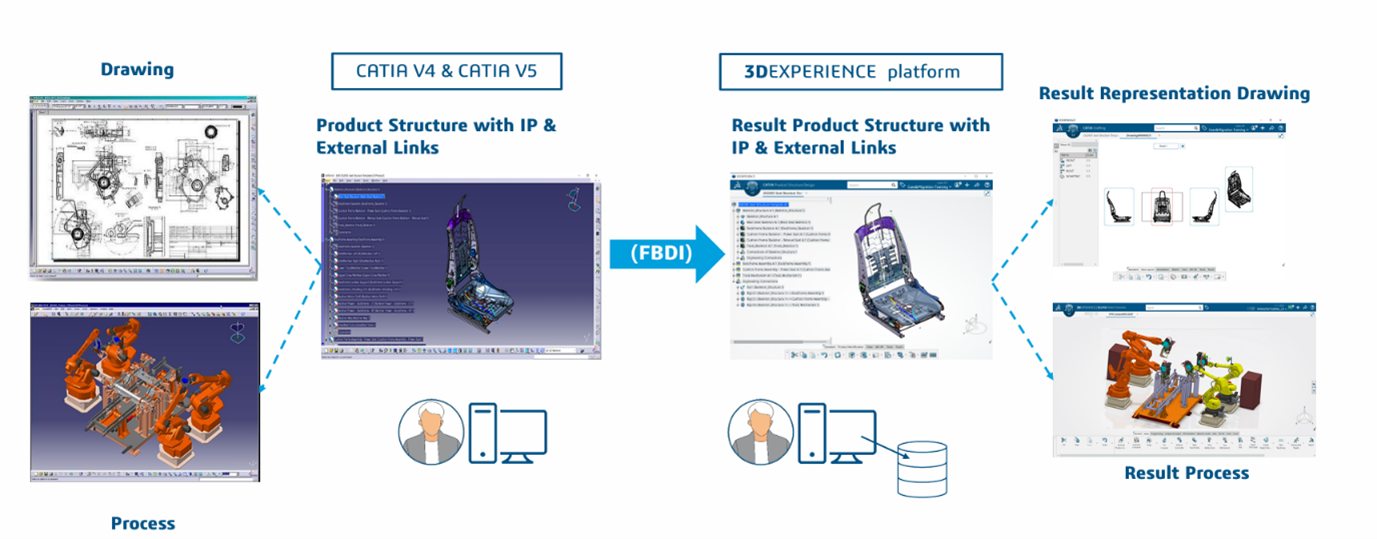
In the quick-paced environment of modern product development, companies are facing mounting pressure to produce innovation more rapidly, collaborate efficiently across worldwide teams, and achieve the highest quality. Conventional design and PLM systems tend to falter in addressing the needs of integrated engineering and digital continuity. Dassault Systèmes’ 3DEXPERIENCE platform responds to these issues by offering a cohesive digital environment that bridges people, data, and processes within one collaborative environment. The transition from legacy environments to the 3DEXPERIENCE platform provides technical and business value many times more profound than mere software upgrades.
The primary advantage of migration comes in the form of data and process unification. In contrast to traditional tools that divide CAD, PLM, and simulation environments, the 3DEXPERIENCE platform unifies all these capabilities into a single unified digital environment. What this implies is that design data, simulation outcomes, documentation, and change histories are all contained in a common data model, precluding version conflicts as well as duplicated data silos. Engineers are able to access real-time data, work on the latest product versions, and make informed choices without having to move between various systems or jeopardize data integrity.
Collaborative innovation is another significant benefit. The 3DEXPERIENCE platform brings teams across disciplines — design, simulation, manufacturing, and project management — together on a cloud or on-premise platform. Collaborators are able to work on shared product structures, handle revisions in real time, and track project progress in integrated dashboards. This real-time connectivity provides greater visibility throughout the product lifecycle, reducing problem-solving time and minimizing development cycles. Additionally, integrated project and lifecycle management applications assure that each change is traceable, approved, and linked to business goals.
Technically, the migration provides smooth integration of design and simulation processes. With applications like CATIA for design, SIMULIA for simulation, and DELMIA for manufacturing, the platform provides end-to-end digital continuity — from concept to production. This allows organizations to carry out early-stage simulations, verify design choices virtually, and optimize performance prior to physical prototyping, leading to cost savings and time-to-market reduction.
The 3DEXPERIENCE platform also enables knowledge-based engineering (KBE) and automation features through the use of tools such as the Engineering Knowledge Language (EKL) and Visual Scripting Designer (VSD). These enable organizations to automate and standardize iterative design operations, apply company standards, and record expert knowledge in reusable templates. Through this, engineering processes become more intelligent, consistent, and efficient while releasing engineers from doing manual modeling to concentrate on innovation.
In comparison to legacy systems, the 3DEXPERIENCE platform provides a future-proof architecture. It can deploy on the cloud for scalability, seamlessly integrates with enterprise systems such as ERP or MES, and offers high-level data analytics for decision support. The model-based approach of the platform also resonates with Industry 4.0 principles, allowing digital twins, virtual validation, and networking manufacturing processes. By integrating design, simulation, and production data into a single ecosystem, businesses can speed up digital transformation and increase business agility.
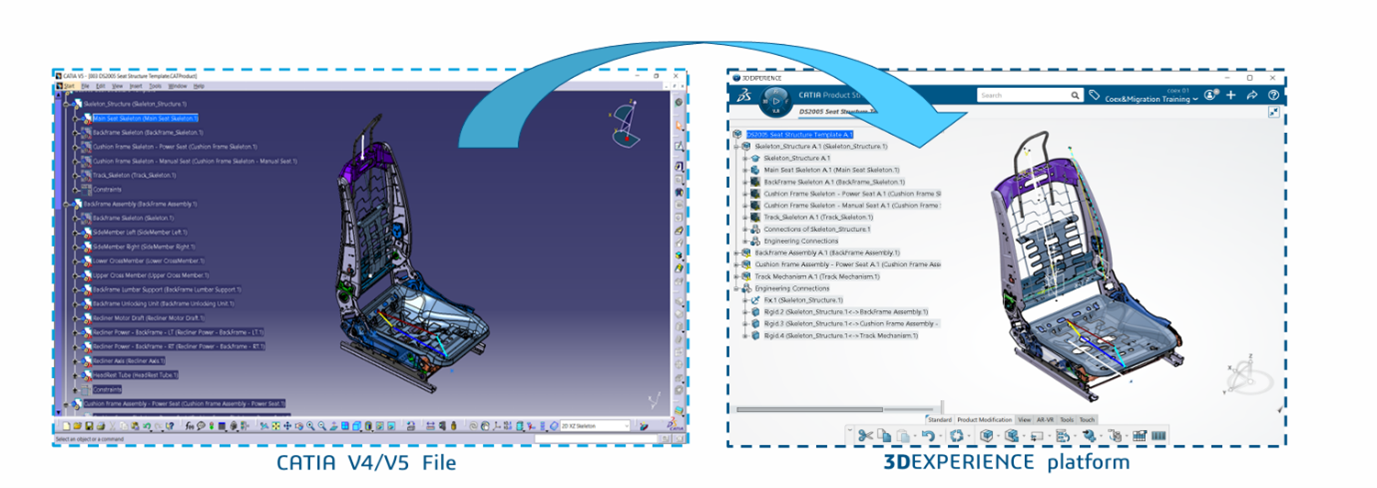
Migration to 3DEXPERIENCE also provides a quantifiable return on investment (ROI). Through the elimination of rework on data, collaboration, and workflows, organizations witness enhanced design efficiency and accelerated delivery of products. The integrated environment keeps IT overheads at a low through the deployment of a single central platform that integrates multiple isolated systems, lowering maintenance as well as integration costs. Additionally, its role-based license allows every user to obtain the tools they require, maximizing utilization of resources across the teams.
Finally, the migration to the 3DEXPERIENCE platform is not just a software change — it is a strategic move towards a fully integrated, collaborative, and smart product development space. It enables organizations to bring people, data, and processes together under a single digital umbrella, generating innovation, efficiency, and competitiveness in this connected world. Whatever the purpose, be it modernizing existing systems, supporting greater cross-domain collaboration, or gearing up for the next generation of digital engineering, the 3DEXPERIENCE platform is the ultimate platform for delivering real digital continuity and sustainable innovation.

Recent Posts
-
3DEXPERIENCE CATIA Composite Design – Delivering Next-Generation Precision for Advanced Composite Structures
3DEXPERIENCE CATIA Composite Design is an advanced, collaborative, and highly integrated engineering solution designed to manage the complexity of modern composite structures used across aerospace,…
-

Innovating with Light: Advanced Optical Solutions for Automotive, Medical, and Photonic Systems
The rapidly evolving optical industry demands cutting-edge systems with exceptional precision and accuracy. As the market for these advanced solutions grows, engineers and manufacturers must…
-
Parametric Modeling to Improve Design Efficiency in 3DEXPERIENCE CATIA
Parametric modeling is more than applying dimensions and constraints – it is about capturing design intent so that changes can be made without rework. In 3DEXPERIENCE CATIA, well-planned parametric models reduce redesign time, improve collaboration,…
-
Configuring Collaborative Spaces in 3DEXPERIENCE for Large Teams
In large organizations, effective collaboration is critical. 3DEXPERIENCE provides Collaborative Spaces, enabling teams to work concurrently on designs, manage data securely, and maintain version control.…
-
3DEXPERIENCE Web Apps – A Complete Guide to Classic Web Applications
The 3DEXPERIENCE Web Apps – Classic User’s Guide explains the common tools, user interface, and functionalities provided by Collaboration and Approvals, which are used across…
-
3DEXPERIENCE in the Automotive Industry: Use Cases & Benefits for OEMs, Tier-1 Suppliers, and EV Manufacturers
The automotive industry is evolving at an unprecedented pace. OEMs are under pressure to reduce time to market, Tier-1 suppliers must align closely with multiple…
-
Understanding Dashboards in the 3DEXPERIENCE Platform
In today’s digital engineering environment, information is valuable only when it is clearly visible, well connected, and easy to understand. The 3DEXPERIENCE Platform addresses this…
-

3DEXPERIENCE Native Apps: A Unified, Intelligent Design Environment
The 3DEXPERIENCE Native Apps form the core working environment for designers, engineers, and collaborators who require powerful authoring, visualization, and data management capabilities directly on…
- Jayesh Darji
- December 16, 2025
Discover the Business Value of Migrating to the 3DEXPERIENCE Platform
In the quick-paced environment of modern product development, companies are facing mounting pressure to produce innovation more rapidly, collaborate efficiently across worldwide teams, and achieve the highest quality. Conventional design and PLM systems tend to falter in addressing the needs of integrated engineering and digital continuity. Dassault Systèmes’ 3DEXPERIENCE platform responds to these issues by offering a cohesive digital environment that bridges people, data, and processes within one collaborative environment. The transition from legacy environments to the 3DEXPERIENCE platform provides technical and business value many times more profound than mere software upgrades.
The primary advantage of migration comes in the form of data and process unification. In contrast to traditional tools that divide CAD, PLM, and simulation environments, the 3DEXPERIENCE platform unifies all these capabilities into a single unified digital environment. What this implies is that design data, simulation outcomes, documentation, and change histories are all contained in a common data model, precluding version conflicts as well as duplicated data silos. Engineers are able to access real-time data, work on the latest product versions, and make informed choices without having to move between various systems or jeopardize data integrity.
Collaborative innovation is another significant benefit. The 3DEXPERIENCE platform brings teams across disciplines — design, simulation, manufacturing, and project management — together on a cloud or on-premise platform. Collaborators are able to work on shared product structures, handle revisions in real time, and track project progress in integrated dashboards. This real-time connectivity provides greater visibility throughout the product lifecycle, reducing problem-solving time and minimizing development cycles. Additionally, integrated project and lifecycle management applications assure that each change is traceable, approved, and linked to business goals.
Technically, the migration provides smooth integration of design and simulation processes. With applications like CATIA for design, SIMULIA for simulation, and DELMIA for manufacturing, the platform provides end-to-end digital continuity — from concept to production. This allows organizations to carry out early-stage simulations, verify design choices virtually, and optimize performance prior to physical prototyping, leading to cost savings and time-to-market reduction.
The 3DEXPERIENCE platform also enables knowledge-based engineering (KBE) and automation features through the use of tools such as the Engineering Knowledge Language (EKL) and Visual Scripting Designer (VSD). These enable organizations to automate and standardize iterative design operations, apply company standards, and record expert knowledge in reusable templates. Through this, engineering processes become more intelligent, consistent, and efficient while releasing engineers from doing manual modeling to concentrate on innovation.
In comparison to legacy systems, the 3DEXPERIENCE platform provides a future-proof architecture. It can deploy on the cloud for scalability, seamlessly integrates with enterprise systems such as ERP or MES, and offers high-level data analytics for decision support. The model-based approach of the platform also resonates with Industry 4.0 principles, allowing digital twins, virtual validation, and networking manufacturing processes. By integrating design, simulation, and production data into a single ecosystem, businesses can speed up digital transformation and increase business agility.
Migration to 3DEXPERIENCE also provides a quantifiable return on investment (ROI). Through the elimination of rework on data, collaboration, and workflows, organizations witness enhanced design efficiency and accelerated delivery of products. The integrated environment keeps IT overheads at a low through the deployment of a single central platform that integrates multiple isolated systems, lowering maintenance as well as integration costs. Additionally, its role-based license allows every user to obtain the tools they require, maximizing utilization of resources across the teams.
Finally, the migration to the 3DEXPERIENCE platform is not just a software change — it is a strategic move towards a fully integrated, collaborative, and smart product development space. It enables organizations to bring people, data, and processes together under a single digital umbrella, generating innovation, efficiency, and competitiveness in this connected world. Whatever the purpose, be it modernizing existing systems, supporting greater cross-domain collaboration, or gearing up for the next generation of digital engineering, the 3DEXPERIENCE platform is the ultimate platform for delivering real digital continuity and sustainable innovation.