Beyond the Test Track: The Virtual Leap in Automotive Lighting Assessment

- Niharika R K
- July 31, 2025
The adoption of innovative technologies such as virtual reality and visual interface in the automotive sector is significantly transforming design visualization. This is also extended to the exterior lighting systems of vehicles. It is crucial to realize the performance of automotive front lighting systems during night driving scenarios where visibility plays a vital role in ensuring safety of drivers and other road users. Factors such as light beam distribution, veiling glare, and optimal visibility must be tested under actual on-road conditions to accurately assess headlamp performance.
Traditionally, beam pattern analysis is carried out on test tracks using physical measuring devices. This approach is restrictive as it necessitates physical headlamp systems for testing, which are only accessible during the final stages of product development and is ineffective for dynamic testing, particularly with the new lamp systems that feature AFS (Adaptive Front-lighting System) and ADB (Adaptive Driving Beam). Additionally, adverse weather conditions and varying environmental factors such as ambient lighting and humidity will prolong the duration of testing. This results in increased costs and resource usage, with minimal opportunity for product enhancement.
LucidDrive, a night driving simulator helps assess automotive headlamps with an emphasis on visual analysis of headlamp light distribution in various road scenarios. It provides a virtual test drive in realistic driving environments. It is an interactive tool with the ability to switch between different lamp sets, driver view positions and road types.
Creating Custom Roads & Realistic Driving Scenarios
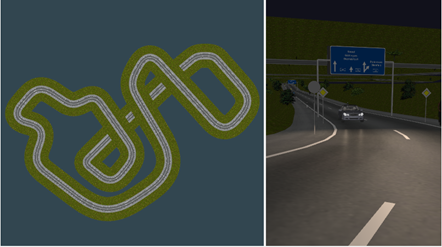
- Road Editor tool helps create custom test tracks and various road scenes like city or country roads, bridges, tunnels and highways, using just the polyline or spline curves.
- Overhead sign boards, trees, poles, road markers and pedestrians can be added to create realistic driving scenarios.
Beam Pattern Analysis of Headlamps
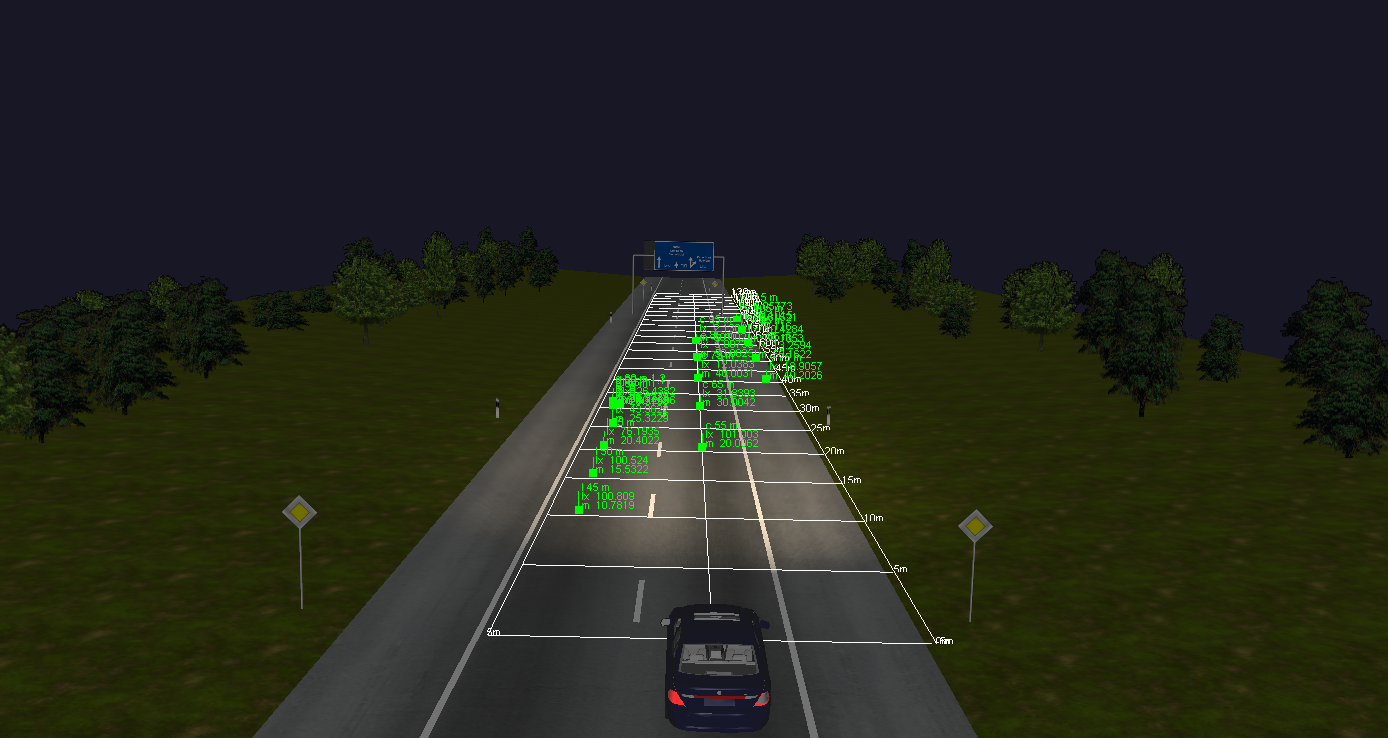
- Mount different headlamps by defining their separation widths, height and aiming positions.
- Switch between various sets of headlamps to see the differences in beam patterns
- Define distance marker lines to provide target positions for visibility benchmarking.
- Add sensors on road, sign boards and other vehicles to determine the lux values at various locations.
Simulate Pixel Light Technology with AFS Masking
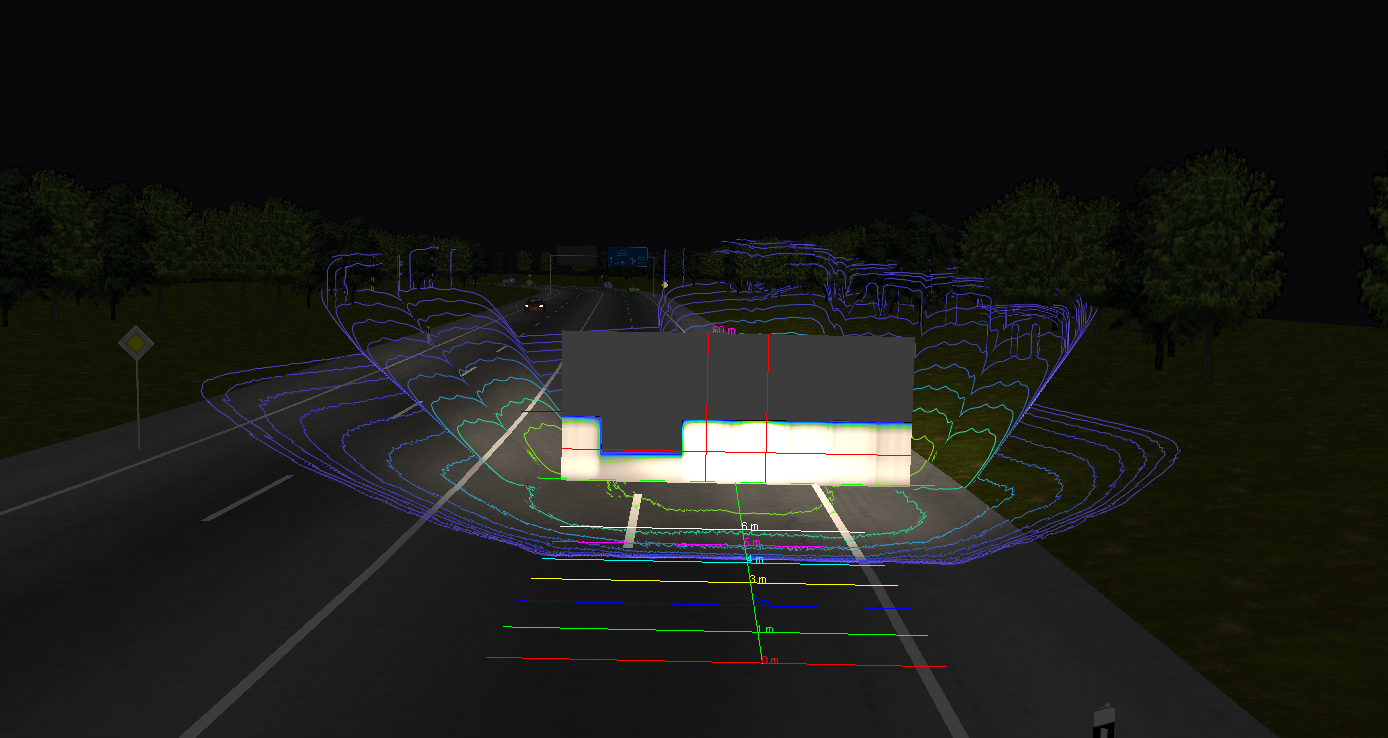
LucidDrive simulates pixel light technology by detecting oncoming or overtaking traffic, and calculating bounding boxes. Defining a dimming matrix to quickly configure pixel light distributions. The sensor allows storage of dynamic light distribution and dimming matrix for each frame.
Realistic Traffic Simulations
- Set user-defined parameters, such as vehicle speed, acceleration, deceleration and braking capabilities.
- Simulate customized vehicle behaviour such as lane changing and overtaking.
This feature provides realistic simulations of headlight response to dynamic traffic and road conditions.
Multiple Views of Headlamp Beam Patterns
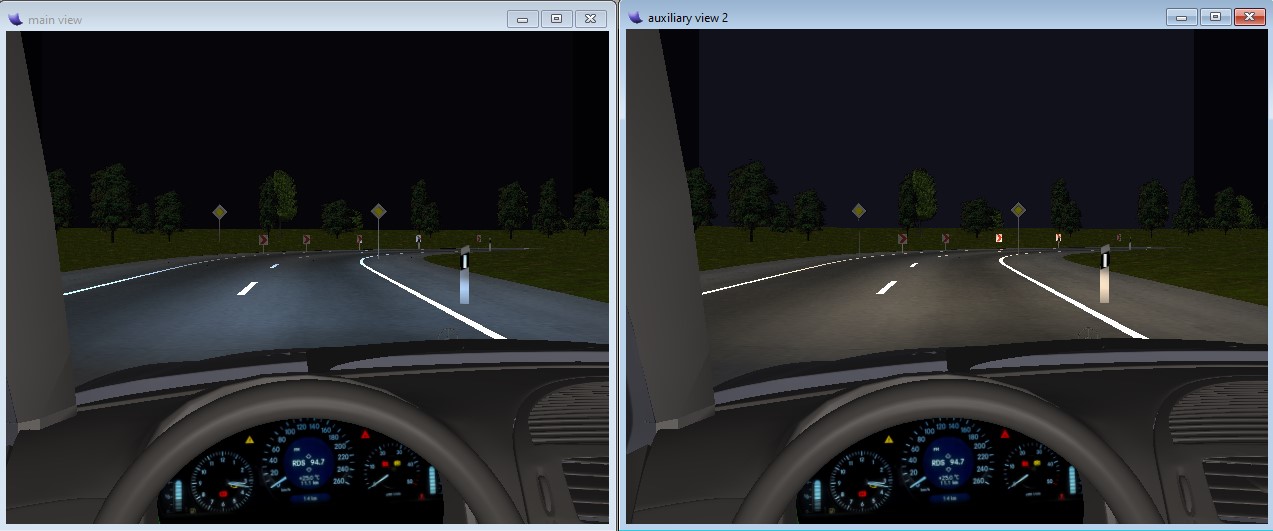
This feature helps compare multiple headlamp beam patterns simultaneously. It enables to determine the most optimal light distribution when different design configurations are being tested. For spectrally generated intensity distribution (.LID/.IES), it is possible to view colour dispersion effects. It also offers different view positions such as the driver’s view, bird’s eye view, drone and pedestrian view which helps visualize the extent of the beam footprint over a large area.
The integration of this visual technology in new product development process will help envision the complete market ready product without the need for any physical prototypes. This improves qualitative decision making and substantially reduces development time and costs.
Recent Posts
-
3DEXPERIENCE CATIA Composite Design – Delivering Next-Generation Precision for Advanced Composite Structures
3DEXPERIENCE CATIA Composite Design is an advanced, collaborative, and highly integrated engineering solution designed to manage the complexity of modern composite structures used across aerospace,…
-
Innovating with Light: Advanced Optical Solutions for Automotive, Medical, and Photonic Systems
The rapidly evolving optical industry demands cutting-edge systems with exceptional precision and accuracy. As the market for these advanced solutions grows, engineers and manufacturers must…
-
Parametric Modeling to Improve Design Efficiency in 3DEXPERIENCE CATIA
Parametric modeling is more than applying dimensions and constraints – it is about capturing design intent so that changes can be made without rework. In 3DEXPERIENCE CATIA, well-planned parametric models reduce redesign time, improve collaboration,…
-

Configuring Collaborative Spaces in 3DEXPERIENCE for Large Teams
In large organizations, effective collaboration is critical. 3DEXPERIENCE provides Collaborative Spaces, enabling teams to work concurrently on designs, manage data securely, and maintain version control.…
-
3DEXPERIENCE Web Apps – A Complete Guide to Classic Web Applications
The 3DEXPERIENCE Web Apps – Classic User’s Guide explains the common tools, user interface, and functionalities provided by Collaboration and Approvals, which are used across…
-
3DEXPERIENCE in the Automotive Industry: Use Cases & Benefits for OEMs, Tier-1 Suppliers, and EV Manufacturers
The automotive industry is evolving at an unprecedented pace. OEMs are under pressure to reduce time to market, Tier-1 suppliers must align closely with multiple…
-
Understanding Dashboards in the 3DEXPERIENCE Platform
In today’s digital engineering environment, information is valuable only when it is clearly visible, well connected, and easy to understand. The 3DEXPERIENCE Platform addresses this…
-

3DEXPERIENCE Native Apps: A Unified, Intelligent Design Environment
The 3DEXPERIENCE Native Apps form the core working environment for designers, engineers, and collaborators who require powerful authoring, visualization, and data management capabilities directly on…
- Niharika R K
- July 31, 2025
Beyond the Test Track: The Virtual Leap in Automotive Lighting Assessment
The adoption of innovative technologies such as virtual reality and visual interface in the automotive sector is significantly transforming design visualization. This is also extended to the exterior lighting systems of vehicles. It is crucial to realize the performance of automotive front lighting systems during night driving scenarios where visibility plays a vital role in ensuring safety of drivers and other road users. Factors such as light beam distribution, veiling glare, and optimal visibility must be tested under actual on-road conditions to accurately assess headlamp performance.
Traditionally, beam pattern analysis is carried out on test tracks using physical measuring devices. This approach is restrictive as it necessitates physical headlamp systems for testing, which are only accessible during the final stages of product development and is ineffective for dynamic testing, particularly with the new lamp systems that feature AFS (Adaptive Front-lighting System) and ADB (Adaptive Driving Beam). Additionally, adverse weather conditions and varying environmental factors such as ambient lighting and humidity will prolong the duration of testing. This results in increased costs and resource usage, with minimal opportunity for product enhancement.
LucidDrive, a night driving simulator helps assess automotive headlamps with an emphasis on visual analysis of headlamp light distribution in various road scenarios. It provides a virtual test drive in realistic driving environments. It is an interactive tool with the ability to switch between different lamp sets, driver view positions and road types.
Creating Custom Roads & Realistic Driving Scenarios
- Road Editor tool helps create custom test tracks and various road scenes like city or country roads, bridges, tunnels and highways, using just the polyline or spline curves.
- Overhead sign boards, trees, poles, road markers and pedestrians can be added to create realistic driving scenarios.
Beam Pattern Analysis of Headlamps
- Mount different headlamps by defining their separation widths, height and aiming positions.
- Switch between various sets of headlamps to see the differences in beam patterns
- Define distance marker lines to provide target positions for visibility benchmarking.
- Add sensors on road, sign boards and other vehicles to determine the lux values at various locations.
Simulate Pixel Light Technology with AFS Masking
LucidDrive simulates pixel light technology by detecting oncoming or overtaking traffic, and calculating bounding boxes. Defining a dimming matrix to quickly configure pixel light distributions. The sensor allows storage of dynamic light distribution and dimming matrix for each frame.
Realistic Traffic Simulations
- Set user-defined parameters, such as vehicle speed, acceleration, deceleration and braking capabilities.
- Simulate customized vehicle behaviour such as lane changing and overtaking.
This feature provides realistic simulations of headlight response to dynamic traffic and road conditions.
Multiple Views of Headlamp Beam Patterns
This feature helps compare multiple headlamp beam patterns simultaneously. It enables to determine the most optimal light distribution when different design configurations are being tested. For spectrally generated intensity distribution (.LID/.IES), it is possible to view colour dispersion effects. It also offers different view positions such as the driver’s view, bird’s eye view, drone and pedestrian view which helps visualize the extent of the beam footprint over a large area.
The integration of this visual technology in new product development process will help envision the complete market ready product without the need for any physical prototypes. This improves qualitative decision making and substantially reduces development time and costs.