Automatic Design: Precision Optimization for Peak Imaging System Performance

- Niharika R K
- October 14, 2025
Design for any imaging system starts with a set of requirements such as focal length, field of view, image size and resolution. Selecting the appropriate first-order layout from the design library or sample lenses, closest to the specification is beneficial, yet it is often the simplest aspect of the design process. The initial design is plagued with various spherical and chromatic aberrations that degrade image quality and fails to account for any physical limitations or manufacturing tolerances. It is necessary to find a balance between meeting performance requirements and staying within budget. The primary challenge is to overcome the inherent trade-offs between these goals to achieve an optimal design that can be effectively implemented when coupled with physical constraints and manufacturing cost.
The anatomy of a lens is defined by how precisely the design is rectified to eliminate its intrinsic imperfections. The traditional method of correcting these flaws, a manual process of trial and error is extremely time consuming. Manipulation of several variables simultaneously, such as the curvature, thickness, or material of the lens, leads to the realization that correcting one aberration worsens another. This necessitates an endless cycle of design iterations which ultimately stagnates the product development cycle.
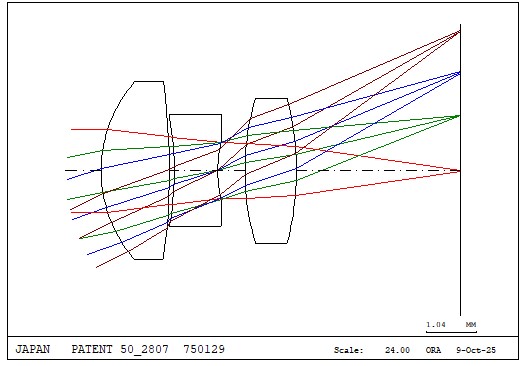
Leveraging CODE V’s powerful optimization tool helps automate the task of finding the best design. This computational process combines image error data into a single value called the error function, that we attempt to make as small as possible. This thorough, iterative approach yields an imaging system that generates clear and distortion-free images. In addition to enhancing performance, it also improves overall efficiency and robustness.
Optimization: Paradigm Shift Towards Automation and Precision
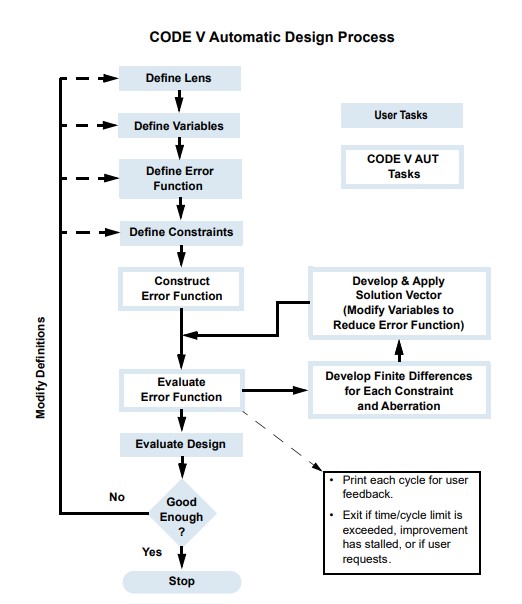
CODE V’s optimization feature called Automatic Design (AUT) uses damped least square algorithm (DLS) to generate changes in variables that improve the system. Constraints defined based on physical dimension, material availability and manufacturing conditions act as boundaries when identifying the ideal solution.
Optimization Workflow in CODE V
- Define as variables all radii of curvatures, thickness values, and fictitious glasses in lens data manager (LDM).
- Make sure all glass elements are thick enough and glass index is not too high to ensure design is cost effective.
- Set specific constraints on parameters that shouldn’t be varied by the optimization process like, effective focal length (EFL), FOV, dimension or glass materials.
- Specify user defined error function or use the default spot size error function in CODE V.
- Draw the lens on each optimization cycle and analyze its modulation transfer function (MTF), point spread function (PSF) and various field aberration curves.
- Additionally, cost analysis evaluates the glass cost and blocking factors which helps compare relative costs of various design.
- Ghost and Narcissus image analysis (GHO, NAR) are paraxially based options for evaluating unwanted secondary images.
Optimization tool is a necessity for modern optical design. It significantly reduces the time it takes to produce a manufacturable design thus enhancing efficiency. Drastically improves device performance and image quality due to its capability of simultaneously varying multiple parameters which is never possible manually. It helps ensure higher yield and lower costs by accounting for design sensitivity towards manufacturing.
In essence, optimization transforms the design process from a labor-intensive, trial-and-error approach into a data-driven, systematic search for the best possible solution.

Recent Posts
-
3DEXPERIENCE CATIA Composite Design – Delivering Next-Generation Precision for Advanced Composite Structures
3DEXPERIENCE CATIA Composite Design is an advanced, collaborative, and highly integrated engineering solution designed to manage the complexity of modern composite structures used across aerospace,…
-

Innovating with Light: Advanced Optical Solutions for Automotive, Medical, and Photonic Systems
The rapidly evolving optical industry demands cutting-edge systems with exceptional precision and accuracy. As the market for these advanced solutions grows, engineers and manufacturers must…
-
Parametric Modeling to Improve Design Efficiency in 3DEXPERIENCE CATIA
Parametric modeling is more than applying dimensions and constraints – it is about capturing design intent so that changes can be made without rework. In 3DEXPERIENCE CATIA, well-planned parametric models reduce redesign time, improve collaboration,…
-

Configuring Collaborative Spaces in 3DEXPERIENCE for Large Teams
In large organizations, effective collaboration is critical. 3DEXPERIENCE provides Collaborative Spaces, enabling teams to work concurrently on designs, manage data securely, and maintain version control.…
-
3DEXPERIENCE Web Apps – A Complete Guide to Classic Web Applications
The 3DEXPERIENCE Web Apps – Classic User’s Guide explains the common tools, user interface, and functionalities provided by Collaboration and Approvals, which are used across…
-
3DEXPERIENCE in the Automotive Industry: Use Cases & Benefits for OEMs, Tier-1 Suppliers, and EV Manufacturers
The automotive industry is evolving at an unprecedented pace. OEMs are under pressure to reduce time to market, Tier-1 suppliers must align closely with multiple…
-
Understanding Dashboards in the 3DEXPERIENCE Platform
In today’s digital engineering environment, information is valuable only when it is clearly visible, well connected, and easy to understand. The 3DEXPERIENCE Platform addresses this…
-

3DEXPERIENCE Native Apps: A Unified, Intelligent Design Environment
The 3DEXPERIENCE Native Apps form the core working environment for designers, engineers, and collaborators who require powerful authoring, visualization, and data management capabilities directly on…
- Niharika R K
- October 14, 2025
Automatic Design: Precision Optimization for Peak Imaging System Performance
Design for any imaging system starts with a set of requirements such as focal length, field of view, image size and resolution. Selecting the appropriate first-order layout from the design library or sample lenses, closest to the specification is beneficial, yet it is often the simplest aspect of the design process. The initial design is plagued with various spherical and chromatic aberrations that degrade image quality and fails to account for any physical limitations or manufacturing tolerances. It is necessary to find a balance between meeting performance requirements and staying within budget. The primary challenge is to overcome the inherent trade-offs between these goals to achieve an optimal design that can be effectively implemented when coupled with physical constraints and manufacturing cost.
The anatomy of a lens is defined by how precisely the design is rectified to eliminate its intrinsic imperfections. The traditional method of correcting these flaws, a manual process of trial and error is extremely time consuming. Manipulation of several variables simultaneously, such as the curvature, thickness, or material of the lens, leads to the realization that correcting one aberration worsens another. This necessitates an endless cycle of design iterations which ultimately stagnates the product development cycle.
Leveraging CODE V’s powerful optimization tool helps automate the task of finding the best design. This computational process combines image error data into a single value called the error function, that we attempt to make as small as possible. This thorough, iterative approach yields an imaging system that generates clear and distortion-free images. In addition to enhancing performance, it also improves overall efficiency and robustness.
Optimization: Paradigm Shift Towards Automation and Precision
CODE V’s optimization feature called Automatic Design (AUT) uses damped least square algorithm (DLS) to generate changes in variables that improve the system. Constraints defined based on physical dimension, material availability and manufacturing conditions act as boundaries when identifying the ideal solution.
Optimization Workflow in CODE V
- Define as variables all radii of curvatures, thickness values, and fictitious glasses in lens data manager (LDM).
- Make sure all glass elements are thick enough and glass index is not too high to ensure design is cost effective.
- Set specific constraints on parameters that shouldn’t be varied by the optimization process like, effective focal length (EFL), FOV, dimension or glass materials.
- Specify user defined error function or use the default spot size error function in CODE V.
- Draw the lens on each optimization cycle and analyze its modulation transfer function (MTF), point spread function (PSF) and various field aberration curves.
- Additionally, cost analysis evaluates the glass cost and blocking factors which helps compare relative costs of various design.
- Ghost and Narcissus image analysis (GHO, NAR) are paraxially based options for evaluating unwanted secondary images.
Optimization tool is a necessity for modern optical design. It significantly reduces the time it takes to produce a manufacturable design thus enhancing efficiency. Drastically improves device performance and image quality due to its capability of simultaneously varying multiple parameters which is never possible manually. It helps ensure higher yield and lower costs by accounting for design sensitivity towards manufacturing.
In essence, optimization transforms the design process from a labor-intensive, trial-and-error approach into a data-driven, systematic search for the best possible solution.