From Classroom to Industry: Empowering Future Engineers with the 3DEXPERIENCE Platform

In today’s fast-evolving engineering and design landscape, educational institutions must go beyond conventional CAD teaching methods. While standalone tools like CATIA V5, SOLIDWORKS, or traditional engineering applications have served academia well for years, the industry has now shifted toward connected, collaborative, lifecycle-driven product development environments. The 3DEXPERIENCE platform by Dassault Systemes perfectly aligns with this transformation, providing universities, engineering colleges, technical institutes, and vocational training centres an industry-relevant digital ecosystem. Rather than just teaching software skills, institutions must now focus on building future-ready engineers, innovators, and digital manufacturing professionals—and 3DEXPERIENCE makes that possible.

3DEXPERIENCE is not just another design software; it is a unified business and engineering platform that integrates design, simulation, manufacturing, collaboration, PLM, and data intelligence into one cloud or on-premises environment. Students learn how real companies operate—managing product structures, change processes, digital continuity, multidisciplinary collaboration, and traceability – skills that industries demand but most graduates lack. When students work within 3DEXPERIENCE, they experience complete product lifecycle workflows: ideation, conceptual design, detailed engineering, virtual validation, manufacturing planning, documentation, and governance. This transform’s learning from tool-usage to system-thinking and enterprise-level engineering understanding.
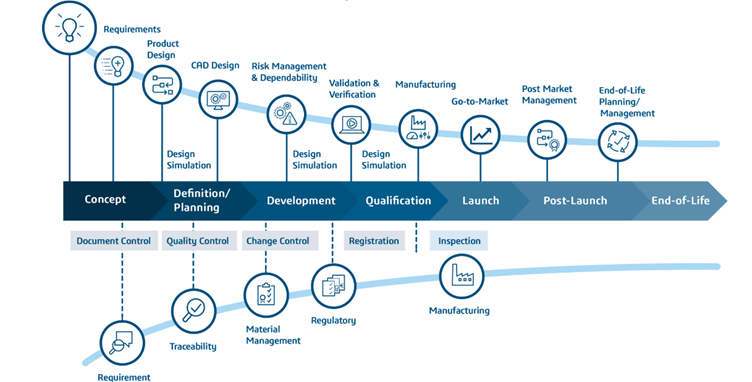
Fig- Product Lifecycle Management (PLM): From Concept to End-of-Life


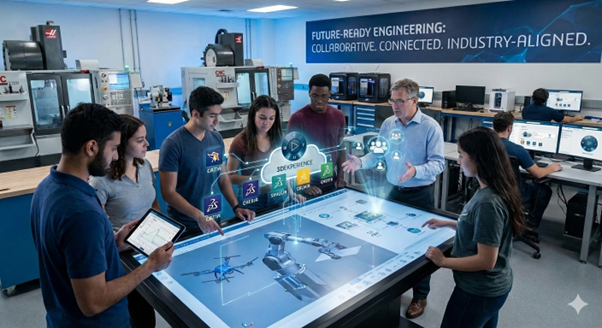
One of the strongest reasons educational institutions need 3DEXPERIENCE is the shift toward collaborative product development. Modern engineering no longer happens in isolated silos. Automotive OEMs, aerospace manufacturers, robotics developers, consumer goods companies, and industrial equipment organizations all work in globally distributed teams. The platform enables role-based access, multi-disciplinary collaboration, and secured data sharing, allowing students to work like real enterprise teams. Faculty can assign team projects where mechanical, manufacturing, electrical, simulation, and management students collaborate on the same digital twin in real time. This nurtures teamwork, communication, leadership, and project management—critical employability skills.

Another major benefit is exposure to digital twin and systems engineering methodologies. Today’s smart products integrate mechanical structures, electronics, embedded systems, connectivity, and software. 3DEXPERIENCE provides integrated capabilities like CATIA for advanced design, SIMULIA for multi-physics simulation, DELMIA for manufacturing and robotics, and ENOVIA for PLM governance. Students can design a part, simulate its structural performance, plan manufacturing, and manage revisions without leaving the platform. This reinforces the principles of Model-Based Engineering, enabling students to move naturally from designing 3D geometry to engineering behaviours, performance validation, and manufacturability assessment. This prepares them for Industry 4.0 and smart manufacturing environments.
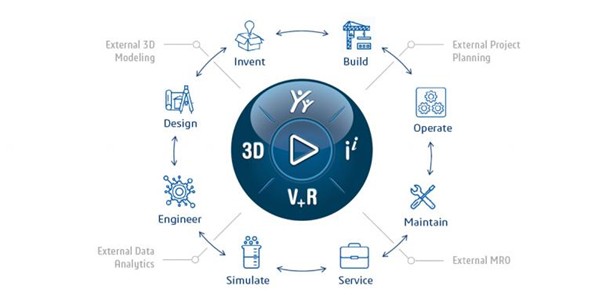
Fig- 3DEXPERIENCE Platform: Connecting Design, Simulation, Manufacturing, and Service


For institutions focusing on research, innovation, startups, and incubation centers, 3DEXPERIENCE provides a robust backbone to accelerate projects and technology development. Whether it is EV design, UAV development, additive manufacturing, biomedical devices, smart mobility systems, or industrial automation, the platform supports advanced simulation, optimization, and virtual testing – reducing prototype cost and research iteration cycles. It also supports data management and IP protection, enabling institutions to securely manage research data and collaborative projects with industries. Access to enterprise-level tools allows students and researchers to work with the same digital infrastructure used by top OEMs worldwide.

From an academic administration perspective, 3DEXPERIENCE also helps institutions modernize their curriculum digitally. Faculty can track student work, evaluate digital submissions, manage versions, and assess engineering thinking rather than just final outputs. Cloud deployment allows remote learning, enabling students to access industry-class tools from anywhere, making it ideal for hybrid and online education models. With structured educational packages, certifications, and academic licensing, institutions can enhance their reputation, strengthen industry tie-ups, and improve student placement outcomes.


In summary, educational institutions need 3DEXPERIENCE not just to teach software, but to transform learning into industry-aligned engineering practice. It bridges the gap between classroom knowledge and enterprise reality, enabling students to gain hands-on exposure to collaborative engineering, PLM processes, systems integration, digital manufacturing, simulation-driven design, and digital twin methodologies. Institutions that adopt 3DEXPERIENCE position themselves as future-ready, empowering students with the competencies required for tomorrow’s engineering challenges and making them highly valuable to global industries. If the goal is to create innovative, skilled, and industry-ready engineers, the 3DEXPERIENCE platform is no longer optional – it is essential.
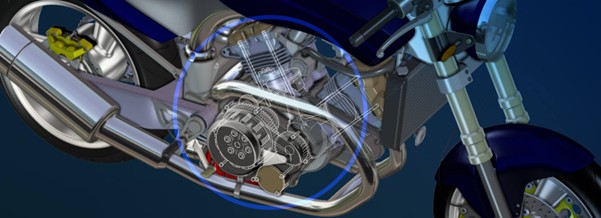
CATIA Composer – Transforming Engineering Data into Interactive Technical Documentation

CATIA Composer is a powerful desktop application from Dassault Systemes designed to transform engineering 3D CAD data into highly intuitive and interactive technical documentation. In today’s engineering and manufacturing environments, clear product communication is as important as design accuracy. Traditional documentation methods using 2D drawings, screenshots, and manually created illustrations often lead to errors, misinterpretations, and delays. CATIA Composer eliminates these issues by allowing organizations to directly reuse existing CAD data from platforms such as CATIA V5, 3DEXPERIENCE, SOLIDWORKS, and standard neutral formats like STEP, IGES, and JT, without requiring design rework or CAD expertise. This enables non-CAD users including manufacturing engineers, technical authors, service teams, and training departments to work efficiently with real engineering models.

One of the biggest advantages of CATIA Composer is its associative link capability. When there is an engineering change in the CAD model, documentation can be updated automatically, ensuring consistency between product evolution and technical publications. This significantly reduces effort, cost, and time while minimizing human dependency and interpretation errors. With CATIA Composer, organizations can create various types of deliverables, including manufacturing assembly instructions, service and maintenance manuals, spare parts catalogues, technical illustrations, interactive 3D content, training material, and even marketing visuals. Its lightweight environment and user-friendly interface allow users to generate exploded views, step-by-step assembly sequences, BOM tables, balloons, leader annotations, and safety indicators with high visual clarity.


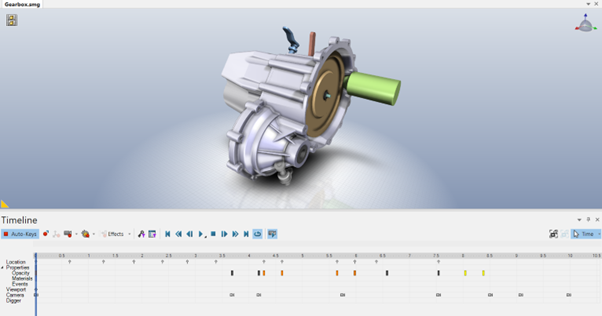
Fig- Dynamic assembly and Disassembly Sequence using timeline-based editing and keyframe controls


CATIA Composer also includes a robust animation engine that allows users to create dynamic assembly and disassembly sequences, maintenance steps, and operational demonstrations using timeline-based editing and keyframe controls. Visual techniques such as ghosting, transparency, section views, and cutaway animations enhance understanding of complex products. Technical illustration tools further enable generation of vector graphics, high-resolution images, and simplified line visuals suitable for manuals and compliance documentation.

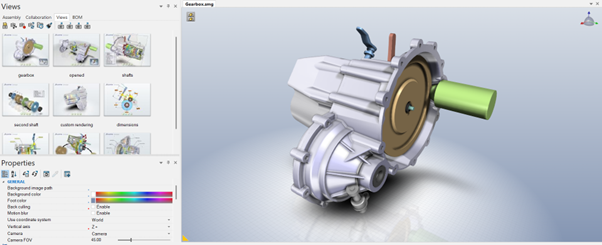
Fig- CATIA Composer Interface Displaying the Views Pane, Properties Panel, and 3D Model Workspace


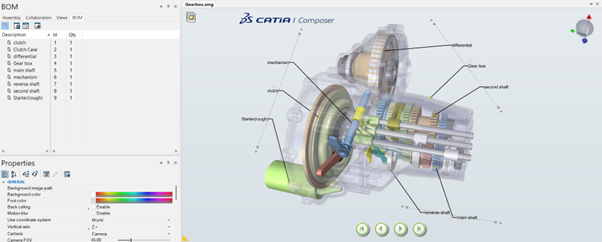
Composer automatically utilizes CAD metadata such as part numbers, descriptions, materials, and revisions, making BOM management and ballooning fast, accurate, and associative.

Fig- CATIA Composer Environment Showing BOM Management and Component Identification


The typical workflow in CATIA Composer begins with importing CAD data and defining product views such as exploded assemblies, service positions, and operational states. Users then apply annotations, BOM information, callouts, measurements, and procedural details. Animations or illustrations are created next, followed by publishing to various formats such as PDF, HTML, images, videos, and interactive SMG files. This flexibility allows organizations to distribute content digitally or traditionally based on requirement.

Fig: Modelled View of the component in Composer

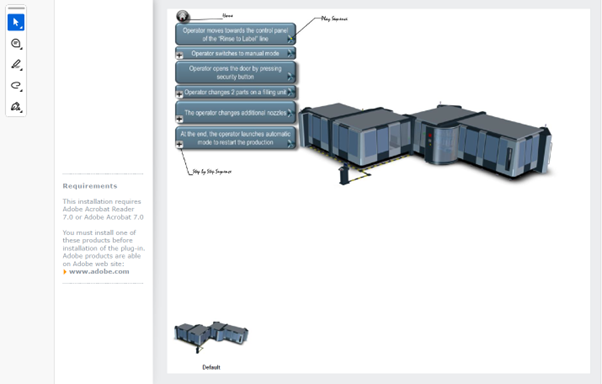
Fig: PDF Documentation Export from CATIA Composer


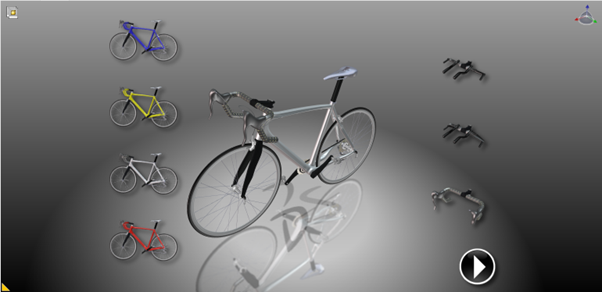
Compared to traditional documentation methods that rely on static screenshots and manually recreated illustrations, CATIA Composer enables the creation of interactive and dynamic technical content. The image illustrates how different product variants can be displayed and integrated within the main 3D model environment. When a specific variant is selected, the corresponding configuration is automatically shown in the central model view, allowing users to visualize design variations clearly. This interactive capability helps technical authors and engineers present multiple product configurations within a single documentation environment, improving clarity, accuracy, and user understanding while reducing the effort required to create separate illustrations for each variant.

Fig- Interactive Product Variant Selection in CATIA Composer

To gain maximum benefit, organizations should maintain structured CAD assemblies, ensure consistent metadata usage, plan documentation strategy early, and use Composer features like named views, layers, and controlled animations effectively. CATIA Composer is widely adopted across industries including automotive, aerospace, heavy machinery, industrial equipment, consumer electronics, and medical devices, where accurate assembly, manufacturing, and service communication is critical. Integrated within the 3DEXPERIENCE ecosystem, it supports managed data environments, secure collaboration, engineering change management, and lifecycle connectivity, creating a single source of truth between design and documentation.


In conclusion, CATIA Composer is more than a visualization tool; it is a strategic communication platform that bridges design, manufacturing, service, training, and customer communication. It enables organizations to produce high-quality, interactive, easily updatable technical content directly from engineering data, thereby reducing errors, improving productivity, supporting faster manufacturing readiness, enhancing service efficiency, and strengthening overall product communication quality. In a world where clarity equals reliability, CATIA Composer plays a vital role in delivering accurate and visually intelligent product information throughout the product lifecycle.

Subscribe to our newsletter

Get all the latest information on Events, Sales and Offers.